
A perfect interface has zero value when the server collapses at the first whip-crack of real traffic.
Friday, November 7, 2025
written by
Co/Founder

Your Site is Beautiful. Too Bad it Doesn’t Sell.
I'll tell you a secret developers won't tell you: most e-commerce sites fail not due to a lack of vision, but due to an unforgivable negligence towards reality. We build cathedrals of elegant code. We create mesmerizing animations. Then Black Friday arrives. And we discover we built a magnificent theater with no plumbing system.
The Friday I Learned the Hard Way
I remember my first real Black Friday. 12:01 AM. We had spent months polishing the project. The client was thrilled. We were proud.
Then the traffic hit like a tidal wave. The site didn't explode. It simply stopped responding. While the visit counter climbed—1,000, 5,000, 10,000—the order counter stayed glued to zero.
The phone started vibrating. The client was in a panic. Sitting in front of that dashboard, I learned the most expensive lesson of my career: Code that works perfectly with ten users isn't simply "slower" with ten thousand. It is a building collapsing under its own weight.
Elegance is Overrated
There is a temptation that afflicts every good developer: The seduction of elegance. We love writing complex, clever functions that make us feel like artists.
But that Black Friday taught me a brutal truth: The server doesn't care if you're smart. The server cares about math.
A single line of inefficient code, executed 50,000 times a minute, becomes a gravitational force that crushes the CPU. Today, my question isn't "Is this code elegant?" My question is: "What happens if I execute it a million times?"
If the answer is "it slows down," we rewrite it. Boredom wins over art. Because a checkout that crashes is worse than a boring checkout that works.
The Debt That Never Sleeps
Here is another way to kill a site: Treating third-party apps as if they were free. It’s easy. One click. You added a new feature.
But every external script is a dead weight attached to your site's ankles. I’ve seen huge campaigns fail not because of our code, but because of a forgotten marketing widget installed months earlier.
Every dependency is a potential breaking point. Today, before adding a library, we ask three questions:
Why can't we build this ourselves?
If this developer disappears tomorrow, how badly are we hurt?
How much extra load does this add?
If the answers aren't convincing, the library stays out. Robust architecture is built by subtracting, not adding.
The Reality Test: Chaos vs. Silence
It is easy for a site to appear fast when you are the only one on it, using a fiber connection. That is an illusion. An empty classroom is always quiet.
Real problems hide during internal tests. They nest in unoptimized database queries. They sleep inside uncompressed images. They wait for the chaos of real traffic to wake up.
I learned never to trust how a site behaves "at rest." The only test that counts is Stress Testing. Scenarios where thousands of users hit the site, connections are slow, and external services fail. If the site survives that, maybe it is ready for the real world.
Defensive Engineering
We write code with a mindset of constant apocalypticism.
We don't think "if" traffic spikes. We think "when".
We don't ask "if" the payment gateway fails. We ask "how do we keep selling when it does?"
This isn't pessimism. It is Defensive Engineering. Because a beautiful site that doesn't load the checkout page isn't an e-commerce store. It is an expensive digital poster.
And our job isn't making posters. It is making the cash register ring.
Epilogue That first Black Friday? We learned. The following month, the site held 500,000 concurrent users without a shudder. It wasn't beautiful. It was boring. It was simple. It was the most beautiful thing I had ever seen.
More Briefs
Tuesday, November 4, 2025
Written by
Mauro Morero
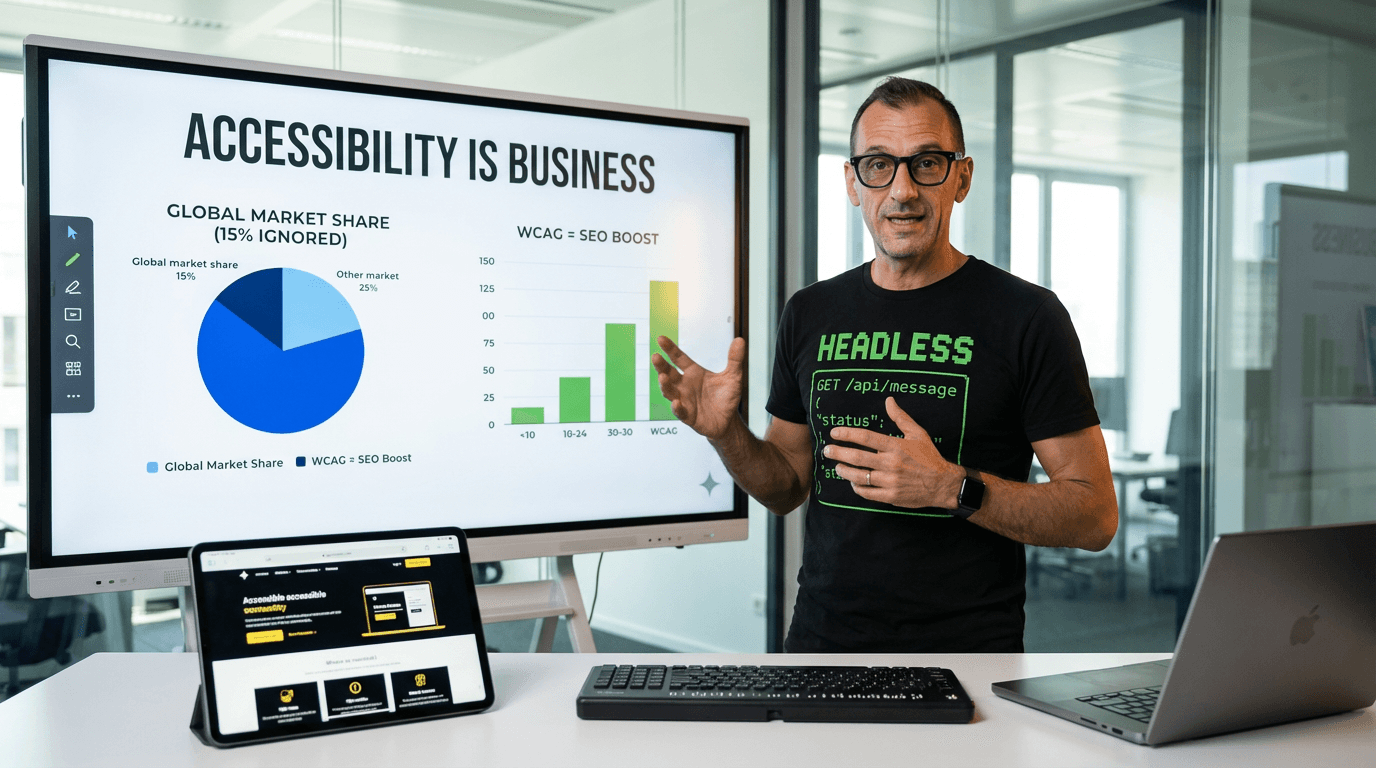
Accessibility is Not Charity. It is Pure Business.
The Uncomfortable Truth: You Are Closing Your Wallet to 1 in 6 Europeans.
In 2025, Europe isn't giving away gifts. The new Digital Accessibility Act is not a favor to the disabled. It is a lifeline thrown to entrepreneurs who still haven't realized they are ignoring a parallel market worth billions. Many brands are scrambling with the mindset of a driver trying to avoid a speeding ticket: "Let's do this to avoid the fine." It is the most expensive strategic error you can make. Because you are looking at the problem from the wrong side of the mirror.

Sunday, October 26, 2025
Written by
Mauro Morero
Innovation is Not a Trend: It is a Responsibility We Didn’t Ask For
Technical innovation that fails to solve a real problem is not innovation. It’s just expensive noise.
In the world of e-commerce, we hear promises of "digital transformation" three times a week. Startups promise to reinvent the wheel. Consultants sell roadmaps copied from other consultants. But the truth no one wants to admit is this: 90% of "innovation" is simply wallpaper over unresolved problems. This article isn't about what is possible with technology. It's about what is actually worth doing.

Tuesday, October 21, 2025
Written by
Alex Andone
Headless: Everyone Talks About It, No One Knows What It Is
Headless is Not a Trend. It’s the Moment You Stop Being a Prisoner of a Theme.
You will hear this word everywhere: Headless. The problem is that no one can explain what it is without boring you to death. Let's solve that problem now. No jargon. Just business.
Tuesday, October 14, 2025
Written by
Mauro Morero
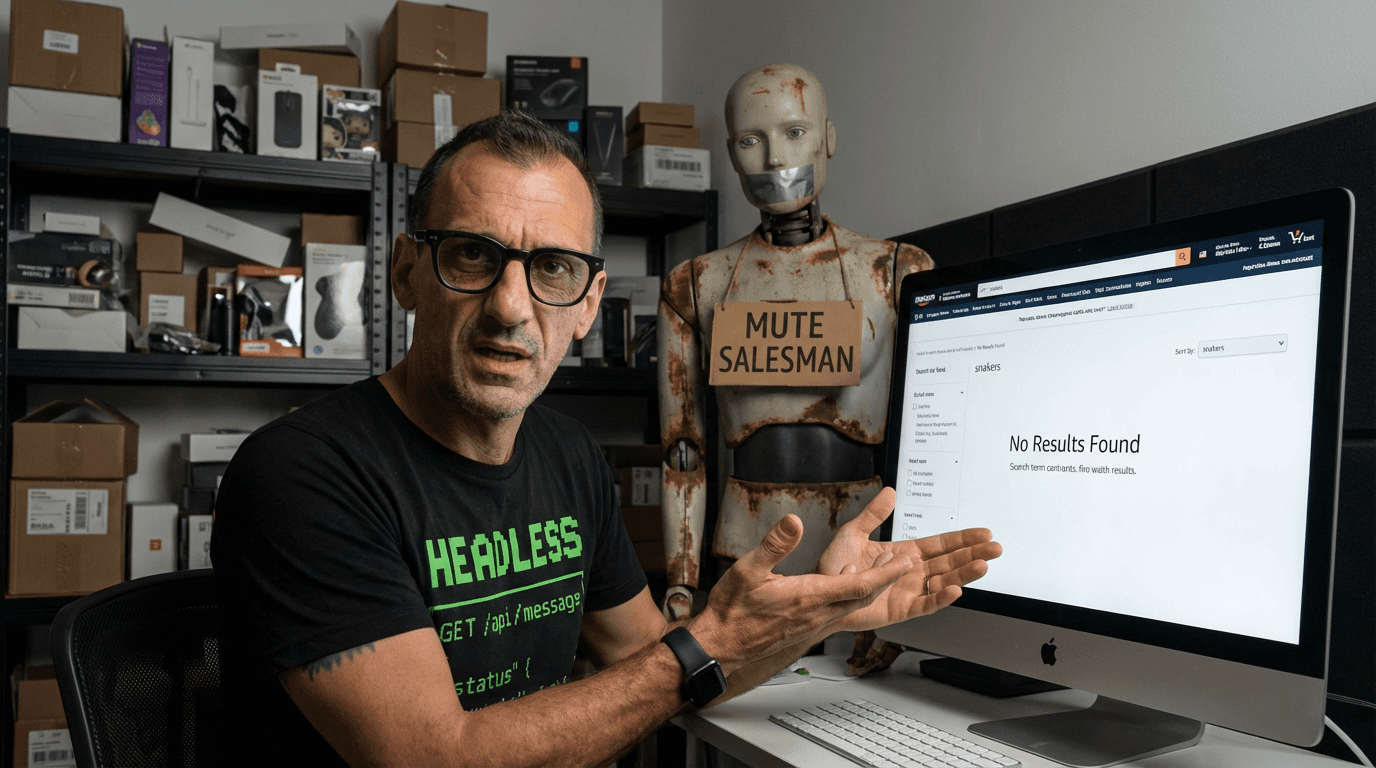
Your Best Salesperson is Mute (And You Are Ignoring Him)
Your site’s search bar converts three times better than any page you have ever designed. Yet you ignore it like the gross profit of a failed startup.
Walk into a store and ask the clerk: "Do you have red running shoes?" If he stares at you in silence or leads you to the cookware aisle, what do you do? You leave. Naturally. Yet, this is the service you offer every single day to your online customers, at scale, with a chilling presumption: that they will keep browsing anyway.
Wednesday, October 1, 2025
Written by
Alex Andone
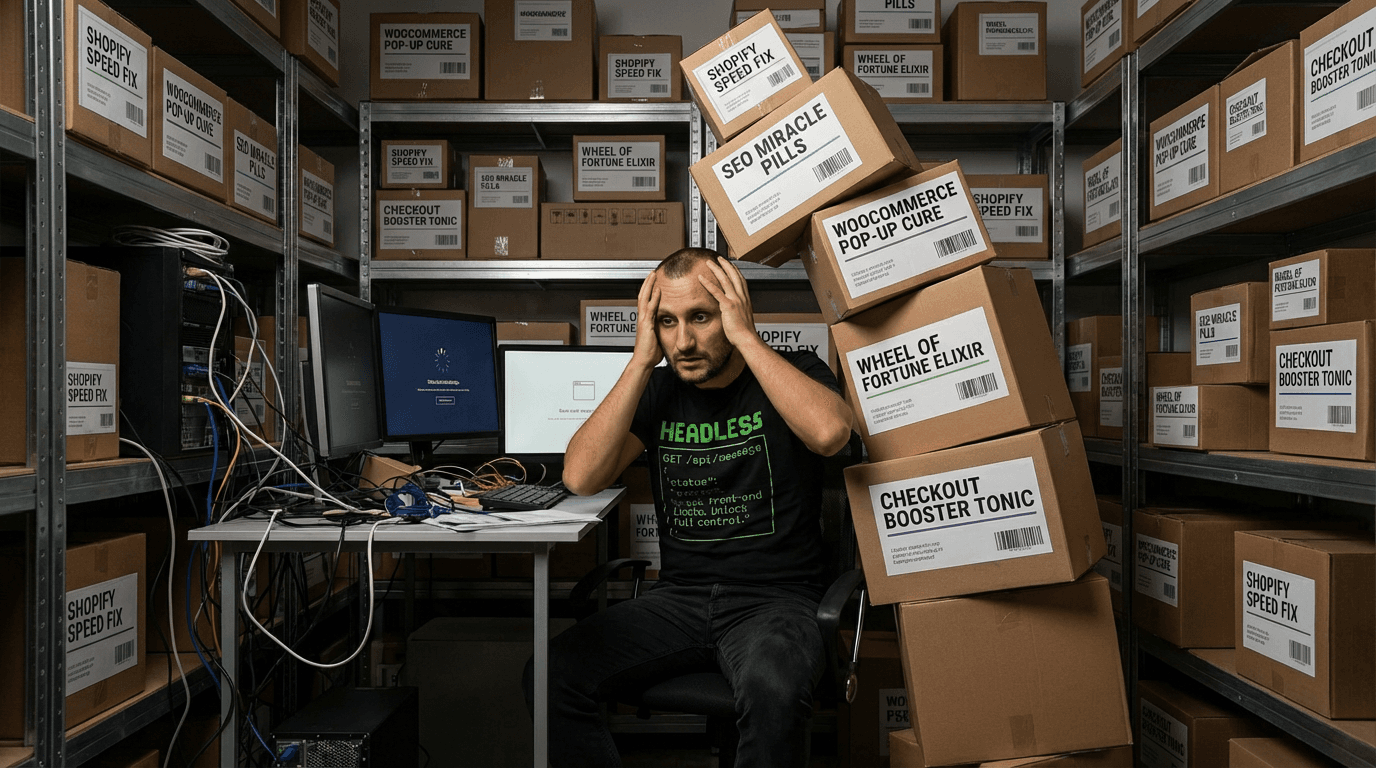
Your E-Commerce Store Doesn’t Need a Pharmacy. It Needs a Detox.
Your e-commerce site isn't slow because you aren't giving it enough traffic. It is slow because you are giving it too many drugs.
Every application you install is a promise of efficiency—and a ticking time bomb. I once thought I was building a modern online store. In reality, I built a museum of bad decisions. If this sounds familiar, you are about to discover why most e-commerce sites suffer from a pathology I call "The Obese Stack," and more importantly, how to cure it.
A perfect interface has zero value when the server collapses at the first whip-crack of real traffic.
Friday, November 7, 2025
written by
Co/Founder
Your Site is Beautiful. Too Bad it Doesn’t Sell.
I'll tell you a secret developers won't tell you: most e-commerce sites fail not due to a lack of vision, but due to an unforgivable negligence towards reality. We build cathedrals of elegant code. We create mesmerizing animations. Then Black Friday arrives. And we discover we built a magnificent theater with no plumbing system.
The Friday I Learned the Hard Way
I remember my first real Black Friday. 12:01 AM. We had spent months polishing the project. The client was thrilled. We were proud.
Then the traffic hit like a tidal wave. The site didn't explode. It simply stopped responding. While the visit counter climbed—1,000, 5,000, 10,000—the order counter stayed glued to zero.
The phone started vibrating. The client was in a panic. Sitting in front of that dashboard, I learned the most expensive lesson of my career: Code that works perfectly with ten users isn't simply "slower" with ten thousand. It is a building collapsing under its own weight.
Elegance is Overrated
There is a temptation that afflicts every good developer: The seduction of elegance. We love writing complex, clever functions that make us feel like artists.
But that Black Friday taught me a brutal truth: The server doesn't care if you're smart. The server cares about math.
A single line of inefficient code, executed 50,000 times a minute, becomes a gravitational force that crushes the CPU. Today, my question isn't "Is this code elegant?" My question is: "What happens if I execute it a million times?"
If the answer is "it slows down," we rewrite it. Boredom wins over art. Because a checkout that crashes is worse than a boring checkout that works.
The Debt That Never Sleeps
Here is another way to kill a site: Treating third-party apps as if they were free. It’s easy. One click. You added a new feature.
But every external script is a dead weight attached to your site's ankles. I’ve seen huge campaigns fail not because of our code, but because of a forgotten marketing widget installed months earlier.
Every dependency is a potential breaking point. Today, before adding a library, we ask three questions:
Why can't we build this ourselves?
If this developer disappears tomorrow, how badly are we hurt?
How much extra load does this add?
If the answers aren't convincing, the library stays out. Robust architecture is built by subtracting, not adding.
The Reality Test: Chaos vs. Silence
It is easy for a site to appear fast when you are the only one on it, using a fiber connection. That is an illusion. An empty classroom is always quiet.
Real problems hide during internal tests. They nest in unoptimized database queries. They sleep inside uncompressed images. They wait for the chaos of real traffic to wake up.
I learned never to trust how a site behaves "at rest." The only test that counts is Stress Testing. Scenarios where thousands of users hit the site, connections are slow, and external services fail. If the site survives that, maybe it is ready for the real world.
Defensive Engineering
We write code with a mindset of constant apocalypticism.
We don't think "if" traffic spikes. We think "when".
We don't ask "if" the payment gateway fails. We ask "how do we keep selling when it does?"
This isn't pessimism. It is Defensive Engineering. Because a beautiful site that doesn't load the checkout page isn't an e-commerce store. It is an expensive digital poster.
And our job isn't making posters. It is making the cash register ring.
Epilogue That first Black Friday? We learned. The following month, the site held 500,000 concurrent users without a shudder. It wasn't beautiful. It was boring. It was simple. It was the most beautiful thing I had ever seen.
More Briefs
Accessibility is Not Charity. It is Pure Business.
The Uncomfortable Truth: You Are Closing Your Wallet to 1 in 6 Europeans.
Innovation is Not a Trend: It is a Responsibility We Didn’t Ask For
Technical innovation that fails to solve a real problem is not innovation. It’s just expensive noise.
Headless: Everyone Talks About It, No One Knows What It Is
Headless is Not a Trend. It’s the Moment You Stop Being a Prisoner of a Theme.
Your Best Salesperson is Mute (And You Are Ignoring Him)
Your site’s search bar converts three times better than any page you have ever designed. Yet you ignore it like the gross profit of a failed startup.
Your E-Commerce Store Doesn’t Need a Pharmacy. It Needs a Detox.
Your e-commerce site isn't slow because you aren't giving it enough traffic. It is slow because you are giving it too many drugs.
A perfect interface has zero value when the server collapses at the first whip-crack of real traffic.
Friday, November 7, 2025
written by
Co/Founder
Your Site is Beautiful. Too Bad it Doesn’t Sell.
I'll tell you a secret developers won't tell you: most e-commerce sites fail not due to a lack of vision, but due to an unforgivable negligence towards reality. We build cathedrals of elegant code. We create mesmerizing animations. Then Black Friday arrives. And we discover we built a magnificent theater with no plumbing system.
The Friday I Learned the Hard Way
I remember my first real Black Friday. 12:01 AM. We had spent months polishing the project. The client was thrilled. We were proud.
Then the traffic hit like a tidal wave. The site didn't explode. It simply stopped responding. While the visit counter climbed—1,000, 5,000, 10,000—the order counter stayed glued to zero.
The phone started vibrating. The client was in a panic. Sitting in front of that dashboard, I learned the most expensive lesson of my career: Code that works perfectly with ten users isn't simply "slower" with ten thousand. It is a building collapsing under its own weight.
Elegance is Overrated
There is a temptation that afflicts every good developer: The seduction of elegance. We love writing complex, clever functions that make us feel like artists.
But that Black Friday taught me a brutal truth: The server doesn't care if you're smart. The server cares about math.
A single line of inefficient code, executed 50,000 times a minute, becomes a gravitational force that crushes the CPU. Today, my question isn't "Is this code elegant?" My question is: "What happens if I execute it a million times?"
If the answer is "it slows down," we rewrite it. Boredom wins over art. Because a checkout that crashes is worse than a boring checkout that works.
The Debt That Never Sleeps
Here is another way to kill a site: Treating third-party apps as if they were free. It’s easy. One click. You added a new feature.
But every external script is a dead weight attached to your site's ankles. I’ve seen huge campaigns fail not because of our code, but because of a forgotten marketing widget installed months earlier.
Every dependency is a potential breaking point. Today, before adding a library, we ask three questions:
Why can't we build this ourselves?
If this developer disappears tomorrow, how badly are we hurt?
How much extra load does this add?
If the answers aren't convincing, the library stays out. Robust architecture is built by subtracting, not adding.
The Reality Test: Chaos vs. Silence
It is easy for a site to appear fast when you are the only one on it, using a fiber connection. That is an illusion. An empty classroom is always quiet.
Real problems hide during internal tests. They nest in unoptimized database queries. They sleep inside uncompressed images. They wait for the chaos of real traffic to wake up.
I learned never to trust how a site behaves "at rest." The only test that counts is Stress Testing. Scenarios where thousands of users hit the site, connections are slow, and external services fail. If the site survives that, maybe it is ready for the real world.
Defensive Engineering
We write code with a mindset of constant apocalypticism.
We don't think "if" traffic spikes. We think "when".
We don't ask "if" the payment gateway fails. We ask "how do we keep selling when it does?"
This isn't pessimism. It is Defensive Engineering. Because a beautiful site that doesn't load the checkout page isn't an e-commerce store. It is an expensive digital poster.
And our job isn't making posters. It is making the cash register ring.
Epilogue That first Black Friday? We learned. The following month, the site held 500,000 concurrent users without a shudder. It wasn't beautiful. It was boring. It was simple. It was the most beautiful thing I had ever seen.
More Briefs
Accessibility is Not Charity. It is Pure Business.
The Uncomfortable Truth: You Are Closing Your Wallet to 1 in 6 Europeans.
Innovation is Not a Trend: It is a Responsibility We Didn’t Ask For
Technical innovation that fails to solve a real problem is not innovation. It’s just expensive noise.
Headless: Everyone Talks About It, No One Knows What It Is
Headless is Not a Trend. It’s the Moment You Stop Being a Prisoner of a Theme.
Your Best Salesperson is Mute (And You Are Ignoring Him)
Your site’s search bar converts three times better than any page you have ever designed. Yet you ignore it like the gross profit of a failed startup.
Your E-Commerce Store Doesn’t Need a Pharmacy. It Needs a Detox.
Your e-commerce site isn't slow because you aren't giving it enough traffic. It is slow because you are giving it too many drugs.

Let's talk.
Partners,
not vendors.
No sales scripts. Just an honest conversation about your objectives. Book a slot directly with our experts to see if we are the right strategic fit for your brand.

Let's talk.
Partners,
not vendors.
No sales scripts. Just an honest conversation about your objectives. Book a slot directly with our experts to see if we are the right strategic fit for your brand.
Let's talk.
Partners,
not vendors.
No sales scripts. Just an honest conversation about your objectives. Book a slot directly with our experts to see if we are the right strategic fit for your brand.