The Uncomfortable Truth: You Are Closing Your Wallet to 1 in 6 Europeans.
Tuesday, November 4, 2025

written by
Co/Founder

Accessibility is Not Charity. It is Pure Business.
In 2025, Europe isn't giving away gifts. The new Digital Accessibility Act is not a favor to the disabled. It is a lifeline thrown to entrepreneurs who still haven't realized they are ignoring a parallel market worth billions.Many brands are scrambling with the mindset of a driver trying to avoid a speeding ticket: "Let's do this to avoid the fine." It is the most expensive strategic error you can make. Because you are looking at the problem from the wrong side of the mirror.
The Number Everyone Ignores
Advertising that doesn't sell is art. The same principle applies to the web. If your digital strategy ignores accessibility, you are simply rejecting money from the wallets of 15% of the world's population.
Let’s talk concrete numbers: in European countries alone, there are roughly 87 million people with some form of disability. This is not a niche to be pitied. It is a market segment that spends, buys, and decides where to invest their hard-earned money.
When you talk about accessibility, you aren't discussing charity disguised as social responsibility. You are talking about people who are right now looking for what you sell, but can't find it because your site is built as if they were invisible.
People with vision issues who can't read your low-contrast text.
People with motor difficulties who can't use a mouse and find your site navigatable only by clicks.
People with dyslexia facing justified text walls and microscopic fonts.
People with color blindness who can't distinguish your "Buy" buttons from the background.
Every time one of them leaves your site, they aren't suffering a limitation. They are choosing a competitor. The one who says: "You are welcome here."
Calculating the cost is easy. If 15% of your potential audience cannot access your services, you are eliminating 15% of your potential revenue. Not due to lack of demand. Due to structural stupidity. A brand that voluntarily rejects 15% of customers is a brand that deserves to struggle for every sale.
The Secret Your Competitors Haven't Figured Out Yet
Here is the fascinating trick no one tells you about digital accessibility. When you build a site compliant with WCAG standards, you aren't just helping the disabled. You are improving the experience for everyone.
An accessible site is logically structured. The hierarchy is clear. Navigation is predictable. Code is clean and semantic. Load times are optimized. And do you know who loves logically structured sites with semantic code and fast load times? Google.
Google's algorithms reward exactly the features that make a site accessible.
Better organic ranking.
Faster indexing.
Lower ad spend for visibility.
More profit.
It isn't magic. It is engineering. When you optimize for accessibility, you optimize for good design. And good design sells. Always.
The Real Cost of Negligence
Here is where many managers wake up. Yes, the 2025 regulations bring fines. Big ones. But the real cost of negligence isn't measured in euros of fines. It is measured in lost opportunity.
Every non-accessible site is a company that decided to be "bad" by accident. They confused the initial cost of compliance with a sterile tax, failing to see that compliance reduces bounce rates, increases time on site, and boosts Lifetime Value.
The real cost is not selling to 87 million people. It is competing with a strategic disadvantage while smart competitors position themselves as the only brands that don't reject a significant part of humanity.
Furthermore—and this surprises many—accessibility principles don't just help the disabled in the traditional sense.
A senior citizen benefits from high contrast.
A person using a phone in bright sunlight benefits from clear UI.
A driver listening to content benefits from clear captions.
A person reading in the dark benefits from Dark Mode.
Accessibility is not a feature. It is smart design.
The Strategic Window is Closing
In 2025, the window is closing. There are two types of companies: those already adapting, and those waiting for the first non-compliance notice. It isn't hard to guess which one will have the competitive edge.
Ogilvy said: "If you don't invest, you don't progress." Waiting until the last minute isn't prudence. It is delayed self-harm. Hasty compliance leads to superficial implementations that satisfy the letter of the law but not the spirit. A site that is "technically" accessible but still hard to use won't sell more.
Investing now turns a legal obligation into a market advantage. It means understanding that the money of a disabled person is worth exactly the same as anyone else's. That building for everyone means building better.
The Conclusion That Will Annoy You
Digital accessibility is not charity. It isn't an embarrassing moral tax companies pay to feel good about themselves. It is the smartest, most profitable, and most scalable way to do business in 2025 and beyond.
If you are still thinking of accessibility as an expense to avoid fines, you are already behind. The smart players have stopped telling themselves stories and looked the numbers in the face: The 15% you are ignoring is 15% of your growth left on the table.
"People don't buy what you do. They buy why you do it." In 2025, when a person with a disability finds your site inaccessible and clicks on your competitor's, they aren't just buying a better product. They are buying the why that competitor chose to build for them. And the "Why" sells. Always.
More Briefs
Friday, November 7, 2025
Written by
Alex Andone
Your Site is Beautiful. Too Bad it Doesn’t Sell.
A perfect interface has zero value when the server collapses at the first whip-crack of real traffic.
I'll tell you a secret developers won't tell you: most e-commerce sites fail not due to a lack of vision, but due to an unforgivable negligence towards reality. We build cathedrals of elegant code. We create mesmerizing animations. Then Black Friday arrives. And we discover we built a magnificent theater with no plumbing system.

Sunday, October 26, 2025
Written by
Mauro Morero
Innovation is Not a Trend: It is a Responsibility We Didn’t Ask For
Technical innovation that fails to solve a real problem is not innovation. It’s just expensive noise.
In the world of e-commerce, we hear promises of "digital transformation" three times a week. Startups promise to reinvent the wheel. Consultants sell roadmaps copied from other consultants. But the truth no one wants to admit is this: 90% of "innovation" is simply wallpaper over unresolved problems. This article isn't about what is possible with technology. It's about what is actually worth doing.

Tuesday, October 21, 2025
Written by
Alex Andone
Headless: Everyone Talks About It, No One Knows What It Is
Headless is Not a Trend. It’s the Moment You Stop Being a Prisoner of a Theme.
You will hear this word everywhere: Headless. The problem is that no one can explain what it is without boring you to death. Let's solve that problem now. No jargon. Just business.
Tuesday, October 14, 2025
Written by
Mauro Morero
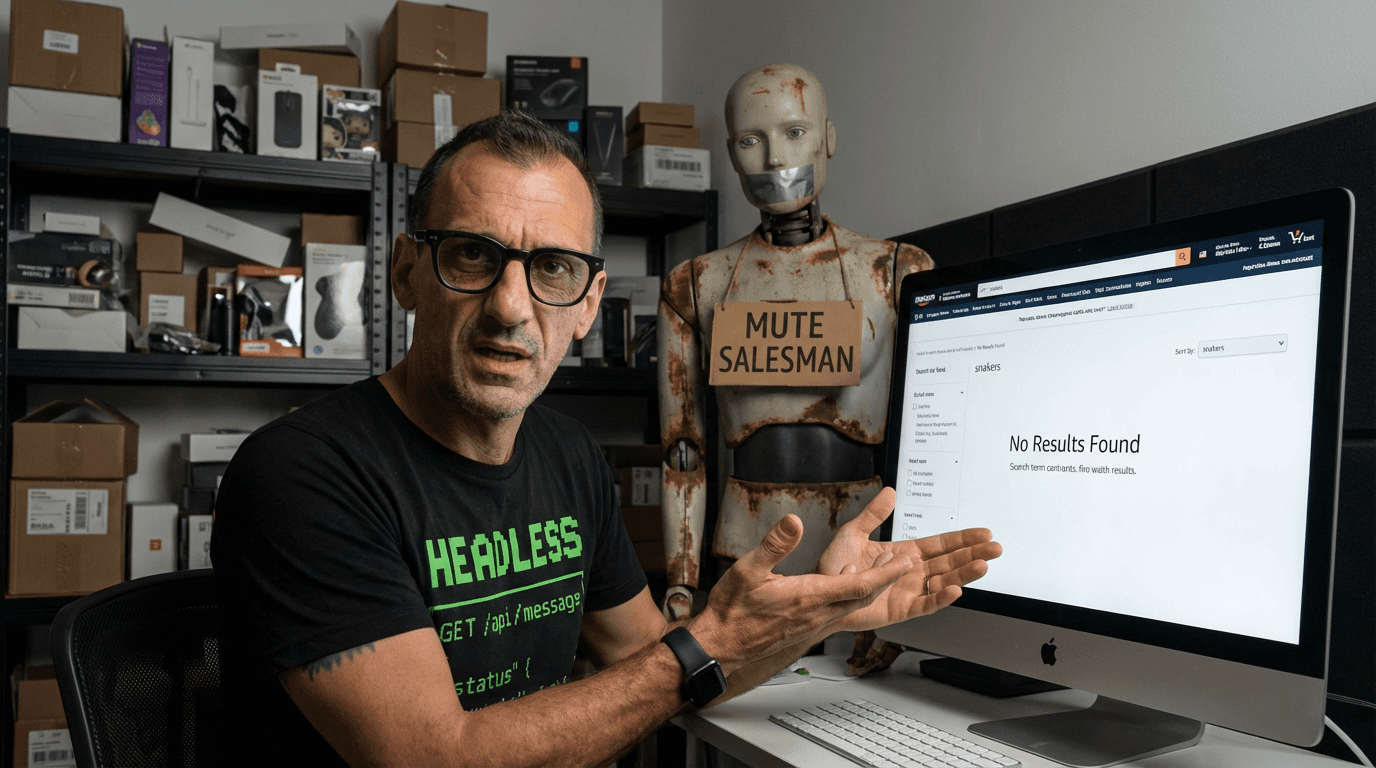
Your Best Salesperson is Mute (And You Are Ignoring Him)
Your site’s search bar converts three times better than any page you have ever designed. Yet you ignore it like the gross profit of a failed startup.
Walk into a store and ask the clerk: "Do you have red running shoes?" If he stares at you in silence or leads you to the cookware aisle, what do you do? You leave. Naturally. Yet, this is the service you offer every single day to your online customers, at scale, with a chilling presumption: that they will keep browsing anyway.

Wednesday, October 1, 2025
Written by
Alex Andone
Your E-Commerce Store Doesn’t Need a Pharmacy. It Needs a Detox.
Your e-commerce site isn't slow because you aren't giving it enough traffic. It is slow because you are giving it too many drugs.
Every application you install is a promise of efficiency—and a ticking time bomb. I once thought I was building a modern online store. In reality, I built a museum of bad decisions. If this sounds familiar, you are about to discover why most e-commerce sites suffer from a pathology I call "The Obese Stack," and more importantly, how to cure it.
The Uncomfortable Truth: You Are Closing Your Wallet to 1 in 6 Europeans.
Tuesday, November 4, 2025
written by
Co/Founder
Accessibility is Not Charity. It is Pure Business.
In 2025, Europe isn't giving away gifts. The new Digital Accessibility Act is not a favor to the disabled. It is a lifeline thrown to entrepreneurs who still haven't realized they are ignoring a parallel market worth billions.Many brands are scrambling with the mindset of a driver trying to avoid a speeding ticket: "Let's do this to avoid the fine." It is the most expensive strategic error you can make. Because you are looking at the problem from the wrong side of the mirror.
The Number Everyone Ignores
Advertising that doesn't sell is art. The same principle applies to the web. If your digital strategy ignores accessibility, you are simply rejecting money from the wallets of 15% of the world's population.
Let’s talk concrete numbers: in European countries alone, there are roughly 87 million people with some form of disability. This is not a niche to be pitied. It is a market segment that spends, buys, and decides where to invest their hard-earned money.
When you talk about accessibility, you aren't discussing charity disguised as social responsibility. You are talking about people who are right now looking for what you sell, but can't find it because your site is built as if they were invisible.
People with vision issues who can't read your low-contrast text.
People with motor difficulties who can't use a mouse and find your site navigatable only by clicks.
People with dyslexia facing justified text walls and microscopic fonts.
People with color blindness who can't distinguish your "Buy" buttons from the background.
Every time one of them leaves your site, they aren't suffering a limitation. They are choosing a competitor. The one who says: "You are welcome here."
Calculating the cost is easy. If 15% of your potential audience cannot access your services, you are eliminating 15% of your potential revenue. Not due to lack of demand. Due to structural stupidity. A brand that voluntarily rejects 15% of customers is a brand that deserves to struggle for every sale.
The Secret Your Competitors Haven't Figured Out Yet
Here is the fascinating trick no one tells you about digital accessibility. When you build a site compliant with WCAG standards, you aren't just helping the disabled. You are improving the experience for everyone.
An accessible site is logically structured. The hierarchy is clear. Navigation is predictable. Code is clean and semantic. Load times are optimized. And do you know who loves logically structured sites with semantic code and fast load times? Google.
Google's algorithms reward exactly the features that make a site accessible.
Better organic ranking.
Faster indexing.
Lower ad spend for visibility.
More profit.
It isn't magic. It is engineering. When you optimize for accessibility, you optimize for good design. And good design sells. Always.
The Real Cost of Negligence
Here is where many managers wake up. Yes, the 2025 regulations bring fines. Big ones. But the real cost of negligence isn't measured in euros of fines. It is measured in lost opportunity.
Every non-accessible site is a company that decided to be "bad" by accident. They confused the initial cost of compliance with a sterile tax, failing to see that compliance reduces bounce rates, increases time on site, and boosts Lifetime Value.
The real cost is not selling to 87 million people. It is competing with a strategic disadvantage while smart competitors position themselves as the only brands that don't reject a significant part of humanity.
Furthermore—and this surprises many—accessibility principles don't just help the disabled in the traditional sense.
A senior citizen benefits from high contrast.
A person using a phone in bright sunlight benefits from clear UI.
A driver listening to content benefits from clear captions.
A person reading in the dark benefits from Dark Mode.
Accessibility is not a feature. It is smart design.
The Strategic Window is Closing
In 2025, the window is closing. There are two types of companies: those already adapting, and those waiting for the first non-compliance notice. It isn't hard to guess which one will have the competitive edge.
Ogilvy said: "If you don't invest, you don't progress." Waiting until the last minute isn't prudence. It is delayed self-harm. Hasty compliance leads to superficial implementations that satisfy the letter of the law but not the spirit. A site that is "technically" accessible but still hard to use won't sell more.
Investing now turns a legal obligation into a market advantage. It means understanding that the money of a disabled person is worth exactly the same as anyone else's. That building for everyone means building better.
The Conclusion That Will Annoy You
Digital accessibility is not charity. It isn't an embarrassing moral tax companies pay to feel good about themselves. It is the smartest, most profitable, and most scalable way to do business in 2025 and beyond.
If you are still thinking of accessibility as an expense to avoid fines, you are already behind. The smart players have stopped telling themselves stories and looked the numbers in the face: The 15% you are ignoring is 15% of your growth left on the table.
"People don't buy what you do. They buy why you do it." In 2025, when a person with a disability finds your site inaccessible and clicks on your competitor's, they aren't just buying a better product. They are buying the why that competitor chose to build for them. And the "Why" sells. Always.
More Briefs
Your Site is Beautiful. Too Bad it Doesn’t Sell.
A perfect interface has zero value when the server collapses at the first whip-crack of real traffic.
Innovation is Not a Trend: It is a Responsibility We Didn’t Ask For
Technical innovation that fails to solve a real problem is not innovation. It’s just expensive noise.
Headless: Everyone Talks About It, No One Knows What It Is
Headless is Not a Trend. It’s the Moment You Stop Being a Prisoner of a Theme.
Your Best Salesperson is Mute (And You Are Ignoring Him)
Your site’s search bar converts three times better than any page you have ever designed. Yet you ignore it like the gross profit of a failed startup.
Your E-Commerce Store Doesn’t Need a Pharmacy. It Needs a Detox.
Your e-commerce site isn't slow because you aren't giving it enough traffic. It is slow because you are giving it too many drugs.
The Uncomfortable Truth: You Are Closing Your Wallet to 1 in 6 Europeans.
Tuesday, November 4, 2025
written by
Co/Founder
Accessibility is Not Charity. It is Pure Business.
In 2025, Europe isn't giving away gifts. The new Digital Accessibility Act is not a favor to the disabled. It is a lifeline thrown to entrepreneurs who still haven't realized they are ignoring a parallel market worth billions.Many brands are scrambling with the mindset of a driver trying to avoid a speeding ticket: "Let's do this to avoid the fine." It is the most expensive strategic error you can make. Because you are looking at the problem from the wrong side of the mirror.
The Number Everyone Ignores
Advertising that doesn't sell is art. The same principle applies to the web. If your digital strategy ignores accessibility, you are simply rejecting money from the wallets of 15% of the world's population.
Let’s talk concrete numbers: in European countries alone, there are roughly 87 million people with some form of disability. This is not a niche to be pitied. It is a market segment that spends, buys, and decides where to invest their hard-earned money.
When you talk about accessibility, you aren't discussing charity disguised as social responsibility. You are talking about people who are right now looking for what you sell, but can't find it because your site is built as if they were invisible.
People with vision issues who can't read your low-contrast text.
People with motor difficulties who can't use a mouse and find your site navigatable only by clicks.
People with dyslexia facing justified text walls and microscopic fonts.
People with color blindness who can't distinguish your "Buy" buttons from the background.
Every time one of them leaves your site, they aren't suffering a limitation. They are choosing a competitor. The one who says: "You are welcome here."
Calculating the cost is easy. If 15% of your potential audience cannot access your services, you are eliminating 15% of your potential revenue. Not due to lack of demand. Due to structural stupidity. A brand that voluntarily rejects 15% of customers is a brand that deserves to struggle for every sale.
The Secret Your Competitors Haven't Figured Out Yet
Here is the fascinating trick no one tells you about digital accessibility. When you build a site compliant with WCAG standards, you aren't just helping the disabled. You are improving the experience for everyone.
An accessible site is logically structured. The hierarchy is clear. Navigation is predictable. Code is clean and semantic. Load times are optimized. And do you know who loves logically structured sites with semantic code and fast load times? Google.
Google's algorithms reward exactly the features that make a site accessible.
Better organic ranking.
Faster indexing.
Lower ad spend for visibility.
More profit.
It isn't magic. It is engineering. When you optimize for accessibility, you optimize for good design. And good design sells. Always.
The Real Cost of Negligence
Here is where many managers wake up. Yes, the 2025 regulations bring fines. Big ones. But the real cost of negligence isn't measured in euros of fines. It is measured in lost opportunity.
Every non-accessible site is a company that decided to be "bad" by accident. They confused the initial cost of compliance with a sterile tax, failing to see that compliance reduces bounce rates, increases time on site, and boosts Lifetime Value.
The real cost is not selling to 87 million people. It is competing with a strategic disadvantage while smart competitors position themselves as the only brands that don't reject a significant part of humanity.
Furthermore—and this surprises many—accessibility principles don't just help the disabled in the traditional sense.
A senior citizen benefits from high contrast.
A person using a phone in bright sunlight benefits from clear UI.
A driver listening to content benefits from clear captions.
A person reading in the dark benefits from Dark Mode.
Accessibility is not a feature. It is smart design.
The Strategic Window is Closing
In 2025, the window is closing. There are two types of companies: those already adapting, and those waiting for the first non-compliance notice. It isn't hard to guess which one will have the competitive edge.
Ogilvy said: "If you don't invest, you don't progress." Waiting until the last minute isn't prudence. It is delayed self-harm. Hasty compliance leads to superficial implementations that satisfy the letter of the law but not the spirit. A site that is "technically" accessible but still hard to use won't sell more.
Investing now turns a legal obligation into a market advantage. It means understanding that the money of a disabled person is worth exactly the same as anyone else's. That building for everyone means building better.
The Conclusion That Will Annoy You
Digital accessibility is not charity. It isn't an embarrassing moral tax companies pay to feel good about themselves. It is the smartest, most profitable, and most scalable way to do business in 2025 and beyond.
If you are still thinking of accessibility as an expense to avoid fines, you are already behind. The smart players have stopped telling themselves stories and looked the numbers in the face: The 15% you are ignoring is 15% of your growth left on the table.
"People don't buy what you do. They buy why you do it." In 2025, when a person with a disability finds your site inaccessible and clicks on your competitor's, they aren't just buying a better product. They are buying the why that competitor chose to build for them. And the "Why" sells. Always.
More Briefs
Your Site is Beautiful. Too Bad it Doesn’t Sell.
A perfect interface has zero value when the server collapses at the first whip-crack of real traffic.
Innovation is Not a Trend: It is a Responsibility We Didn’t Ask For
Technical innovation that fails to solve a real problem is not innovation. It’s just expensive noise.
Headless: Everyone Talks About It, No One Knows What It Is
Headless is Not a Trend. It’s the Moment You Stop Being a Prisoner of a Theme.
Your Best Salesperson is Mute (And You Are Ignoring Him)
Your site’s search bar converts three times better than any page you have ever designed. Yet you ignore it like the gross profit of a failed startup.
Your E-Commerce Store Doesn’t Need a Pharmacy. It Needs a Detox.
Your e-commerce site isn't slow because you aren't giving it enough traffic. It is slow because you are giving it too many drugs.

Let's talk.
Partners,
not vendors.
No sales scripts. Just an honest conversation about your objectives. Book a slot directly with our experts to see if we are the right strategic fit for your brand.

Let's talk.
Partners,
not vendors.
No sales scripts. Just an honest conversation about your objectives. Book a slot directly with our experts to see if we are the right strategic fit for your brand.
Let's talk.
Partners,
not vendors.
No sales scripts. Just an honest conversation about your objectives. Book a slot directly with our experts to see if we are the right strategic fit for your brand.