
Your e-commerce site isn't slow because you aren't giving it enough traffic. It is slow because you are giving it too many drugs.
Wednesday, October 1, 2025

written by
Co/Founder

Your E-Commerce Store Doesn’t Need a Pharmacy. It Needs a Detox.
Every application you install is a promise of efficiency—and a ticking time bomb. I once thought I was building a modern online store. In reality, I built a museum of bad decisions. If this sounds familiar, you are about to discover why most e-commerce sites suffer from a pathology I call "The Obese Stack," and more importantly, how to cure it.
The App Store Paradox
Navigating the Shopify or WooCommerce App Store is like walking into a pharmacy where every shelf promises to cure a different ailment. Headache? There’s an app. Fever? There’s an app. Need a "Spin the Wheel" popup for Easter? Yes, it exists, and it costs $29/month.
The temptation is irresistible. A little blue icon. A description promising miracles. 4.5 stars. You click "Install." Immediate feeling of power. But here is the problem: Every app is not just a new feature.
It is a new commercial relationship.
It is external code living on your domain.
It is a stranger with access to your data.
Most of all, it is pure weight, measured in milliseconds of loading time.
The Obese Stack: When Efficiency Becomes Paralysis
Imagine your site as a human body. Each app is an organ. One or two extra organs? Manageable. Thirty? You are looking at a human being who can’t move.
Here is what happens when you install apps without discipline:
The Weight of Foreign Code. Every app injects JavaScript into your site. It isn't optimized for your store; it is generic code written to work on thousands of sites. That "lightweight" review app? It loads 150KB of JavaScript every time a customer opens a page. Multiply that by 50,000 visitors.
The Carnival of Monthly Fees. $5 here, $15 there, $29 there. Six months later, you are paying $500 a month for features that maybe 30% of your customers actually notice. You are funding developers building software for the 99% use case, when you need your specific 1%.
Invisible Tracking. Every app collects data. While you build a relationship with your customers, an email marketing app is building one too, competing with you. When that app gets acquired, you have zero control over what happens to your customer data.
The Truth No One Tells You
App vendors hate this fact: Speed is a currency. Amazon discovered that every 100 milliseconds of latency costs millions in lost sales. If your site loads in 5 seconds instead of 1, you are giving away 30-40% of your potential sales.
Here is the philosophical problem: You install an upsell app to increase Average Order Value by 2%. But that app slows your site down by 500ms, causing 10% of visitors to bounce before they even see the product. That is negative math. You are destroying the house to build a front door.
The App Sector Has a Conflict of Interest
App creators are incentivized to sell apps, not to tell you if you need them. A vendor who says "Your site is fine, you don't need this" is a vendor who goes out of business.
What you don't see is the e-commerce store 18 months later: 25 apps installed, load times tripled, bugs multiplying faster than fixes.
The Solution: Be a Sculptor, Not a Collector.
Distinguish between two categories:
Peripheral Features. (Spin wheels, fancy popups). Keep them if you must, but treat them as disposable.
Critical Features. (Recommendation engines, Inventory sync).
For critical features, a $9/month app is not a solution. It is a hidden cost. If a feature is critical to your business, own it. Build it into your native theme code. It will be faster, stable, and yours. It won't break when a vendor updates their software. It won't disappear if the vendor goes bankrupt.
The Audit That Should Scare You
Do this exercise today. Open your Shopify dashboard. Look at your apps. Ask these three questions for each one:
Can I live without it? If the answer is "maybe," uninstall it.
How much is it slowing me down? Use GTmetrix. If an app adds 200ms and doesn't generate at least 3% more conversion, it is a liability.
If it disappeared tomorrow, would I panic? If the answer is "no, I'd just have one less feature," then it isn't critical.
I once audited a store with 37 apps. Load time: 4.2 seconds. We deleted 25 apps that generated zero measurable value. Load time dropped to 1.3 seconds. Conversions increased by 23%. We saved $287/month in fees.
Conclusion: Your E-Commerce is an Athlete, Not a Pack Mule
Stop feeding your e-commerce store as if it were a beast of burden. Stop adding weight every time you hear a promise. More features do not mean more sales.
The most profitable companies say "no" to a thousand things and "yes" to the few that matter. Audit your apps today. Tomorrow, you will have a faster site. Next week, higher conversions. Next month, fewer headaches.
Everything else is noise. And noise doesn't sell.
More Briefs
Friday, November 7, 2025
Written by
Alex Andone
Your Site is Beautiful. Too Bad it Doesn’t Sell.
A perfect interface has zero value when the server collapses at the first whip-crack of real traffic.
I'll tell you a secret developers won't tell you: most e-commerce sites fail not due to a lack of vision, but due to an unforgivable negligence towards reality. We build cathedrals of elegant code. We create mesmerizing animations. Then Black Friday arrives. And we discover we built a magnificent theater with no plumbing system.

Tuesday, November 4, 2025
Written by
Mauro Morero
Accessibility is Not Charity. It is Pure Business.
The Uncomfortable Truth: You Are Closing Your Wallet to 1 in 6 Europeans.
In 2025, Europe isn't giving away gifts. The new Digital Accessibility Act is not a favor to the disabled. It is a lifeline thrown to entrepreneurs who still haven't realized they are ignoring a parallel market worth billions. Many brands are scrambling with the mindset of a driver trying to avoid a speeding ticket: "Let's do this to avoid the fine." It is the most expensive strategic error you can make. Because you are looking at the problem from the wrong side of the mirror.

Sunday, October 26, 2025
Written by
Mauro Morero
Innovation is Not a Trend: It is a Responsibility We Didn’t Ask For
Technical innovation that fails to solve a real problem is not innovation. It’s just expensive noise.
In the world of e-commerce, we hear promises of "digital transformation" three times a week. Startups promise to reinvent the wheel. Consultants sell roadmaps copied from other consultants. But the truth no one wants to admit is this: 90% of "innovation" is simply wallpaper over unresolved problems. This article isn't about what is possible with technology. It's about what is actually worth doing.

Tuesday, October 21, 2025
Written by
Alex Andone
Headless: Everyone Talks About It, No One Knows What It Is
Headless is Not a Trend. It’s the Moment You Stop Being a Prisoner of a Theme.
You will hear this word everywhere: Headless. The problem is that no one can explain what it is without boring you to death. Let's solve that problem now. No jargon. Just business.
Tuesday, October 14, 2025
Written by
Mauro Morero
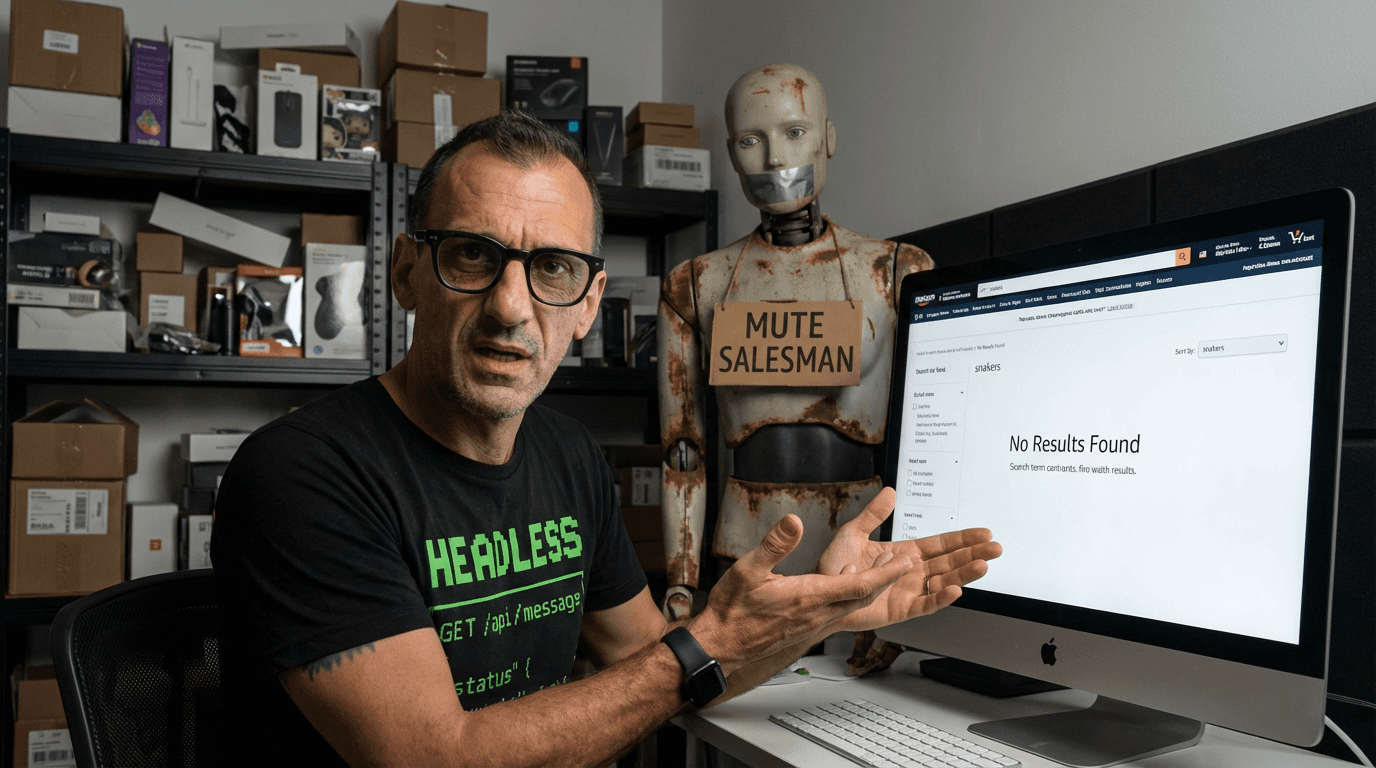
Your Best Salesperson is Mute (And You Are Ignoring Him)
Your site’s search bar converts three times better than any page you have ever designed. Yet you ignore it like the gross profit of a failed startup.
Walk into a store and ask the clerk: "Do you have red running shoes?" If he stares at you in silence or leads you to the cookware aisle, what do you do? You leave. Naturally. Yet, this is the service you offer every single day to your online customers, at scale, with a chilling presumption: that they will keep browsing anyway.
Your e-commerce site isn't slow because you aren't giving it enough traffic. It is slow because you are giving it too many drugs.
Wednesday, October 1, 2025
written by
Co/Founder
Your E-Commerce Store Doesn’t Need a Pharmacy. It Needs a Detox.
Every application you install is a promise of efficiency—and a ticking time bomb. I once thought I was building a modern online store. In reality, I built a museum of bad decisions. If this sounds familiar, you are about to discover why most e-commerce sites suffer from a pathology I call "The Obese Stack," and more importantly, how to cure it.
The App Store Paradox
Navigating the Shopify or WooCommerce App Store is like walking into a pharmacy where every shelf promises to cure a different ailment. Headache? There’s an app. Fever? There’s an app. Need a "Spin the Wheel" popup for Easter? Yes, it exists, and it costs $29/month.
The temptation is irresistible. A little blue icon. A description promising miracles. 4.5 stars. You click "Install." Immediate feeling of power. But here is the problem: Every app is not just a new feature.
It is a new commercial relationship.
It is external code living on your domain.
It is a stranger with access to your data.
Most of all, it is pure weight, measured in milliseconds of loading time.
The Obese Stack: When Efficiency Becomes Paralysis
Imagine your site as a human body. Each app is an organ. One or two extra organs? Manageable. Thirty? You are looking at a human being who can’t move.
Here is what happens when you install apps without discipline:
The Weight of Foreign Code. Every app injects JavaScript into your site. It isn't optimized for your store; it is generic code written to work on thousands of sites. That "lightweight" review app? It loads 150KB of JavaScript every time a customer opens a page. Multiply that by 50,000 visitors.
The Carnival of Monthly Fees. $5 here, $15 there, $29 there. Six months later, you are paying $500 a month for features that maybe 30% of your customers actually notice. You are funding developers building software for the 99% use case, when you need your specific 1%.
Invisible Tracking. Every app collects data. While you build a relationship with your customers, an email marketing app is building one too, competing with you. When that app gets acquired, you have zero control over what happens to your customer data.
The Truth No One Tells You
App vendors hate this fact: Speed is a currency. Amazon discovered that every 100 milliseconds of latency costs millions in lost sales. If your site loads in 5 seconds instead of 1, you are giving away 30-40% of your potential sales.
Here is the philosophical problem: You install an upsell app to increase Average Order Value by 2%. But that app slows your site down by 500ms, causing 10% of visitors to bounce before they even see the product. That is negative math. You are destroying the house to build a front door.
The App Sector Has a Conflict of Interest
App creators are incentivized to sell apps, not to tell you if you need them. A vendor who says "Your site is fine, you don't need this" is a vendor who goes out of business.
What you don't see is the e-commerce store 18 months later: 25 apps installed, load times tripled, bugs multiplying faster than fixes.
The Solution: Be a Sculptor, Not a Collector.
Distinguish between two categories:
Peripheral Features. (Spin wheels, fancy popups). Keep them if you must, but treat them as disposable.
Critical Features. (Recommendation engines, Inventory sync).
For critical features, a $9/month app is not a solution. It is a hidden cost. If a feature is critical to your business, own it. Build it into your native theme code. It will be faster, stable, and yours. It won't break when a vendor updates their software. It won't disappear if the vendor goes bankrupt.
The Audit That Should Scare You
Do this exercise today. Open your Shopify dashboard. Look at your apps. Ask these three questions for each one:
Can I live without it? If the answer is "maybe," uninstall it.
How much is it slowing me down? Use GTmetrix. If an app adds 200ms and doesn't generate at least 3% more conversion, it is a liability.
If it disappeared tomorrow, would I panic? If the answer is "no, I'd just have one less feature," then it isn't critical.
I once audited a store with 37 apps. Load time: 4.2 seconds. We deleted 25 apps that generated zero measurable value. Load time dropped to 1.3 seconds. Conversions increased by 23%. We saved $287/month in fees.
Conclusion: Your E-Commerce is an Athlete, Not a Pack Mule
Stop feeding your e-commerce store as if it were a beast of burden. Stop adding weight every time you hear a promise. More features do not mean more sales.
The most profitable companies say "no" to a thousand things and "yes" to the few that matter. Audit your apps today. Tomorrow, you will have a faster site. Next week, higher conversions. Next month, fewer headaches.
Everything else is noise. And noise doesn't sell.
More Briefs
Your Site is Beautiful. Too Bad it Doesn’t Sell.
A perfect interface has zero value when the server collapses at the first whip-crack of real traffic.
Accessibility is Not Charity. It is Pure Business.
The Uncomfortable Truth: You Are Closing Your Wallet to 1 in 6 Europeans.
Innovation is Not a Trend: It is a Responsibility We Didn’t Ask For
Technical innovation that fails to solve a real problem is not innovation. It’s just expensive noise.
Headless: Everyone Talks About It, No One Knows What It Is
Headless is Not a Trend. It’s the Moment You Stop Being a Prisoner of a Theme.
Your Best Salesperson is Mute (And You Are Ignoring Him)
Your site’s search bar converts three times better than any page you have ever designed. Yet you ignore it like the gross profit of a failed startup.
Your e-commerce site isn't slow because you aren't giving it enough traffic. It is slow because you are giving it too many drugs.
Wednesday, October 1, 2025
written by
Co/Founder
Your E-Commerce Store Doesn’t Need a Pharmacy. It Needs a Detox.
Every application you install is a promise of efficiency—and a ticking time bomb. I once thought I was building a modern online store. In reality, I built a museum of bad decisions. If this sounds familiar, you are about to discover why most e-commerce sites suffer from a pathology I call "The Obese Stack," and more importantly, how to cure it.
The App Store Paradox
Navigating the Shopify or WooCommerce App Store is like walking into a pharmacy where every shelf promises to cure a different ailment. Headache? There’s an app. Fever? There’s an app. Need a "Spin the Wheel" popup for Easter? Yes, it exists, and it costs $29/month.
The temptation is irresistible. A little blue icon. A description promising miracles. 4.5 stars. You click "Install." Immediate feeling of power. But here is the problem: Every app is not just a new feature.
It is a new commercial relationship.
It is external code living on your domain.
It is a stranger with access to your data.
Most of all, it is pure weight, measured in milliseconds of loading time.
The Obese Stack: When Efficiency Becomes Paralysis
Imagine your site as a human body. Each app is an organ. One or two extra organs? Manageable. Thirty? You are looking at a human being who can’t move.
Here is what happens when you install apps without discipline:
The Weight of Foreign Code. Every app injects JavaScript into your site. It isn't optimized for your store; it is generic code written to work on thousands of sites. That "lightweight" review app? It loads 150KB of JavaScript every time a customer opens a page. Multiply that by 50,000 visitors.
The Carnival of Monthly Fees. $5 here, $15 there, $29 there. Six months later, you are paying $500 a month for features that maybe 30% of your customers actually notice. You are funding developers building software for the 99% use case, when you need your specific 1%.
Invisible Tracking. Every app collects data. While you build a relationship with your customers, an email marketing app is building one too, competing with you. When that app gets acquired, you have zero control over what happens to your customer data.
The Truth No One Tells You
App vendors hate this fact: Speed is a currency. Amazon discovered that every 100 milliseconds of latency costs millions in lost sales. If your site loads in 5 seconds instead of 1, you are giving away 30-40% of your potential sales.
Here is the philosophical problem: You install an upsell app to increase Average Order Value by 2%. But that app slows your site down by 500ms, causing 10% of visitors to bounce before they even see the product. That is negative math. You are destroying the house to build a front door.
The App Sector Has a Conflict of Interest
App creators are incentivized to sell apps, not to tell you if you need them. A vendor who says "Your site is fine, you don't need this" is a vendor who goes out of business.
What you don't see is the e-commerce store 18 months later: 25 apps installed, load times tripled, bugs multiplying faster than fixes.
The Solution: Be a Sculptor, Not a Collector.
Distinguish between two categories:
Peripheral Features. (Spin wheels, fancy popups). Keep them if you must, but treat them as disposable.
Critical Features. (Recommendation engines, Inventory sync).
For critical features, a $9/month app is not a solution. It is a hidden cost. If a feature is critical to your business, own it. Build it into your native theme code. It will be faster, stable, and yours. It won't break when a vendor updates their software. It won't disappear if the vendor goes bankrupt.
The Audit That Should Scare You
Do this exercise today. Open your Shopify dashboard. Look at your apps. Ask these three questions for each one:
Can I live without it? If the answer is "maybe," uninstall it.
How much is it slowing me down? Use GTmetrix. If an app adds 200ms and doesn't generate at least 3% more conversion, it is a liability.
If it disappeared tomorrow, would I panic? If the answer is "no, I'd just have one less feature," then it isn't critical.
I once audited a store with 37 apps. Load time: 4.2 seconds. We deleted 25 apps that generated zero measurable value. Load time dropped to 1.3 seconds. Conversions increased by 23%. We saved $287/month in fees.
Conclusion: Your E-Commerce is an Athlete, Not a Pack Mule
Stop feeding your e-commerce store as if it were a beast of burden. Stop adding weight every time you hear a promise. More features do not mean more sales.
The most profitable companies say "no" to a thousand things and "yes" to the few that matter. Audit your apps today. Tomorrow, you will have a faster site. Next week, higher conversions. Next month, fewer headaches.
Everything else is noise. And noise doesn't sell.
More Briefs
Your Site is Beautiful. Too Bad it Doesn’t Sell.
A perfect interface has zero value when the server collapses at the first whip-crack of real traffic.
Accessibility is Not Charity. It is Pure Business.
The Uncomfortable Truth: You Are Closing Your Wallet to 1 in 6 Europeans.
Innovation is Not a Trend: It is a Responsibility We Didn’t Ask For
Technical innovation that fails to solve a real problem is not innovation. It’s just expensive noise.
Headless: Everyone Talks About It, No One Knows What It Is
Headless is Not a Trend. It’s the Moment You Stop Being a Prisoner of a Theme.
Your Best Salesperson is Mute (And You Are Ignoring Him)
Your site’s search bar converts three times better than any page you have ever designed. Yet you ignore it like the gross profit of a failed startup.

Let's talk.
Partners,
not vendors.
No sales scripts. Just an honest conversation about your objectives. Book a slot directly with our experts to see if we are the right strategic fit for your brand.

Let's talk.
Partners,
not vendors.
No sales scripts. Just an honest conversation about your objectives. Book a slot directly with our experts to see if we are the right strategic fit for your brand.
Let's talk.
Partners,
not vendors.
No sales scripts. Just an honest conversation about your objectives. Book a slot directly with our experts to see if we are the right strategic fit for your brand.