
Headless is Not a Trend. It’s the Moment You Stop Being a Prisoner of a Theme.
Tuesday, October 21, 2025
written by
Co/Founder

Headless: Everyone Talks About It, No One Knows What It Is
You will hear this word everywhere: Headless. The problem is that no one can explain what it is without boring you to death. Let's solve that problem now. No jargon. Just business.
Traditional Architecture: A Comfortable Prison
Before understanding Headless, you must understand what it means to be non-headless.
Imagine your traditional e-commerce store—the one you use on Shopify or another standard platform—as a prefabricated house. Everything is pre-assembled. The walls, the roof, the windows come from a catalog. It is solid, functional, delivered in two weeks, and costs little.
You live well in it. Until you notice a fundamental flaw: the backend and the frontend are welded together.
The Backend is the engine (orders, products, money).
The Frontend is the paint (what the customer sees).
In a traditional setup, these two worlds are chained. If you want to change the frontend, the backend often says "no." If you want extreme performance, the backend holds you back because it wasn't built for speed—it was built for safety.
The result? Three enormous problems:
Mediocre Speed. Every time a customer opens a page, the server reconstructs it from scratch. A millisecond here, a second there. The page "builds" itself before the customer's eyes. It’s adequate, but adequate loses you 7-8% of conversions.
The Illusion of Creativity. Your designer draws something wonderful. The developer says: "The theme doesn't support this." Compromise becomes the norm.
You Are Trapped. Your store lives only on the website. Want a mobile app? Start from scratch. Want to sell in the metaverse? Build again. There is no central brain.
Headless: Cutting the Chain
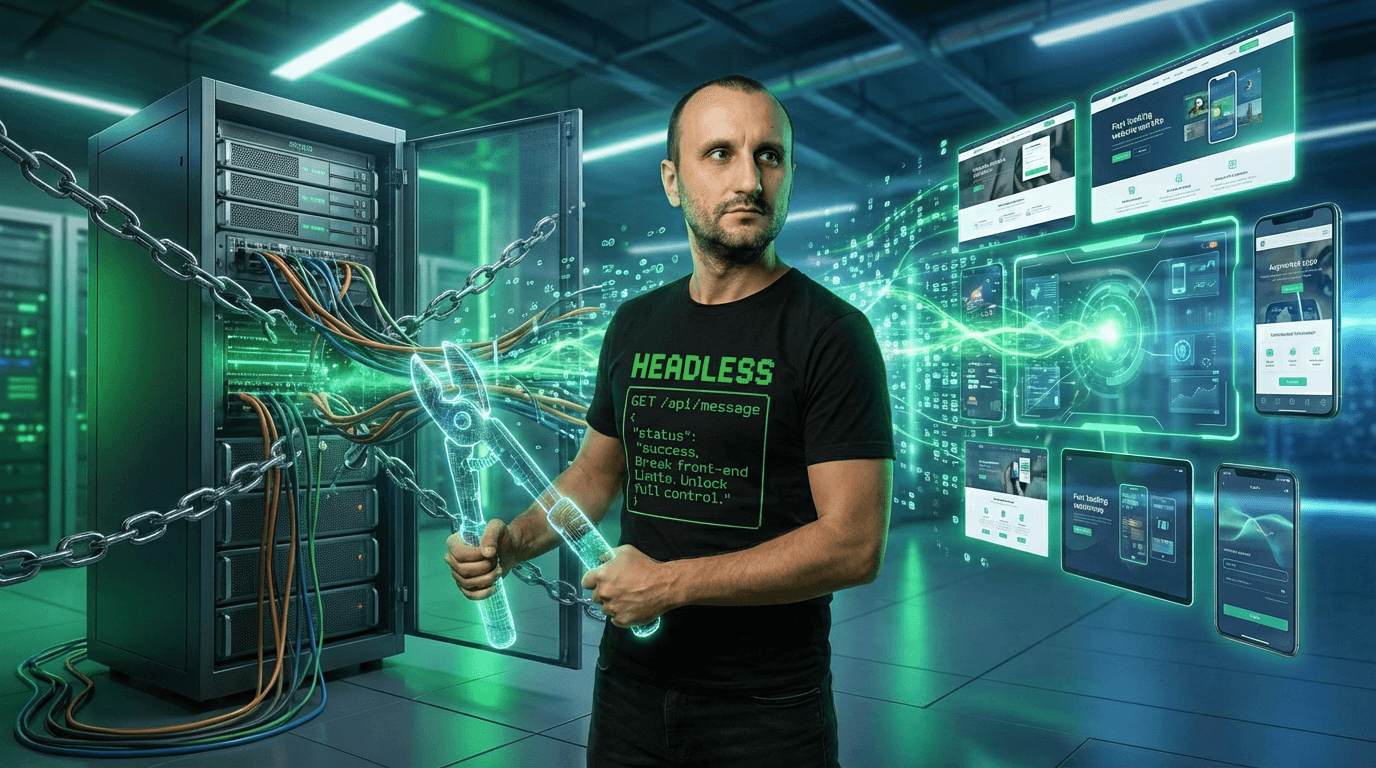
Now comes the revolution. Headless means exactly this: we cut the weld. We divorce the backend from the frontend.
The Backend stays on Shopify. Why? Because Shopify is the best commercial engine in the world. It manages money and logistics perfectly. Replacing it would be like swapping a Formula 1 engine for a lawnmower engine.
The Frontend? We build it from scratch. Brick by brick. Using ultra-modern tech (React, Next.js). The loading speeds change from "fast enough" to instantaneous. The pages don't "load"; they appear.
Here is the magic that follows:
Speed that converts. 40% of visitors abandon a site if it takes more than 3 seconds to load. Headless puts you light years ahead.
Total Freedom. If you can draw it, we can code it. 3D products? Narrative navigation? Hyper-personalization? The frontend is now a blank canvas.
True Omnichannel. Your backend becomes the brain. It sends data to your website, your mobile app, your smartwatch app, or your in-store kiosk. One brain, infinite faces.
The 3 Pillars of Superiority
Allow me to be blunt. Headless wins on three fronts that the market no longer tolerates:
Performance. It isn't just speed; it is psychology. Your brain associates speed with quality. A slow site is a slow brand. An instant site is a brand that knows its stuff.
Conversion. Amazon and Google proved it: every 100 milliseconds of latency reduction increases revenue by 1%. Do the math on your annual turnover. Headless pays for itself.
Invulnerability. Being on five channels simultaneously (Web, App, Social, Retail, IoT) gives you a competitive moat that is nearly impossible to cross.
Who Doesn't Need Headless?
I must be honest. If you sell t-shirts in a small niche, bill €500k a year, and convert at 3%, Headless is a useless luxury. Keep the standard theme. Invest in marketing. Not everyone needs a Ferrari.
But here is the "but" that changes everything. Today you are small. Tomorrow, your competitor implements Headless. Their pages load in 0.8 seconds. They convert at 5%. They have double your budget. You are still competing with a theme identical to ten other brands.
Who needs it today? Brands with vision. Brands that refuse to be commodities. Companies eyeing the metaverse or immersive experiences. If you believe the frontend is part of your identity, not just a technical detail, you need this.
The Hidden Costs of Standing Still
Let’s address the elephant in the room. Headless costs money. It requires skilled developers, maintenance, and governance. It is an investment that makes CFOs squint.
But do you know what costs much more? Standing still.
Losing 8% of conversions monthly because the site is slow.
Being unable to launch a mobile app quickly.
Having a fragile experience dependent on a theme you don't control.
Being one of ten identical brands in your category.
That cost is hidden, but real. It is revenue never realized.
The Final Verdict
Headless isn't the future. It is the present that smart brands have already mastered. Your competitors aren't talking about it yet? Perfect. Start now. In two years, when everyone panics and says "we have to do Headless," you will already be 24 months ahead.
The question isn't: "Should we do Headless?" The question is: "How much longer can we afford not to?"
More Briefs
Friday, November 7, 2025
Written by
Alex Andone
Your Site is Beautiful. Too Bad it Doesn’t Sell.
A perfect interface has zero value when the server collapses at the first whip-crack of real traffic.
I'll tell you a secret developers won't tell you: most e-commerce sites fail not due to a lack of vision, but due to an unforgivable negligence towards reality. We build cathedrals of elegant code. We create mesmerizing animations. Then Black Friday arrives. And we discover we built a magnificent theater with no plumbing system.
Tuesday, November 4, 2025
Written by
Mauro Morero
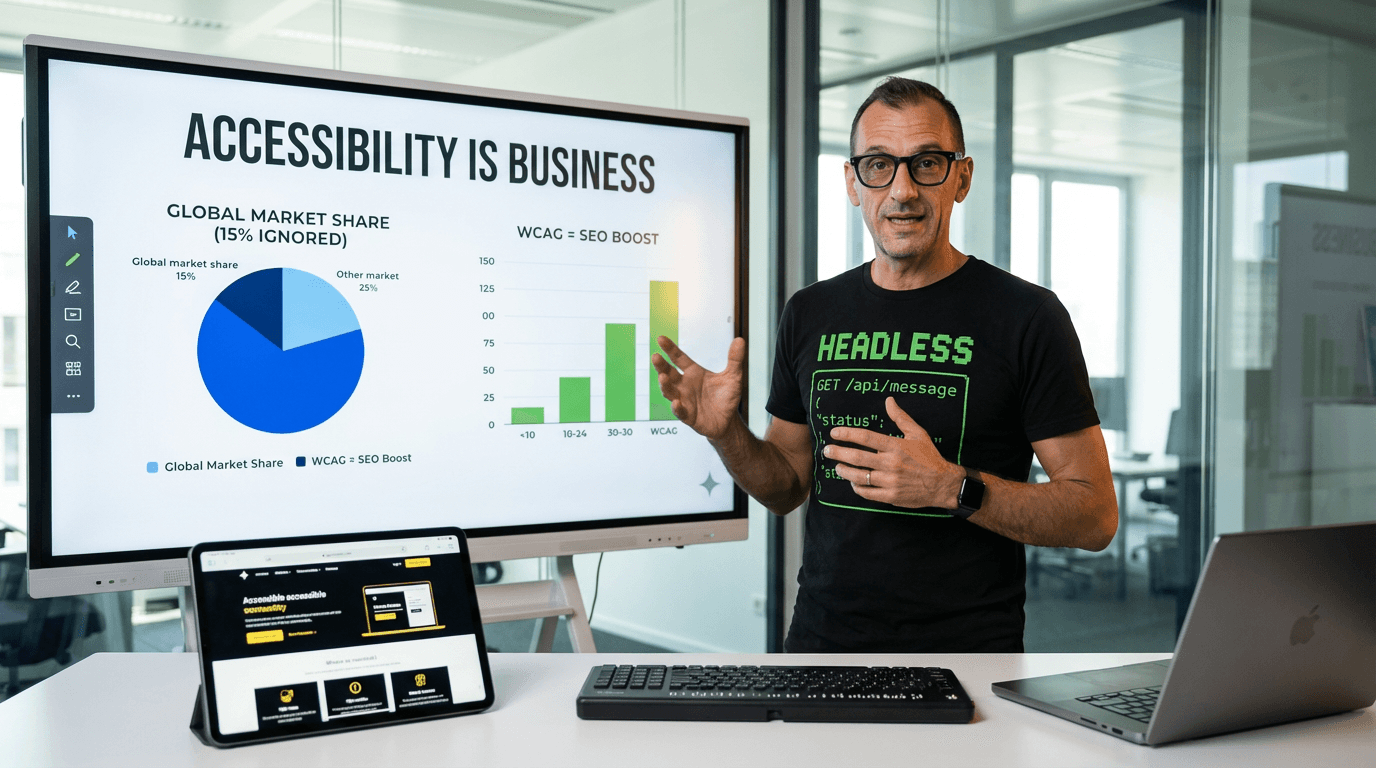
Accessibility is Not Charity. It is Pure Business.
The Uncomfortable Truth: You Are Closing Your Wallet to 1 in 6 Europeans.
In 2025, Europe isn't giving away gifts. The new Digital Accessibility Act is not a favor to the disabled. It is a lifeline thrown to entrepreneurs who still haven't realized they are ignoring a parallel market worth billions. Many brands are scrambling with the mindset of a driver trying to avoid a speeding ticket: "Let's do this to avoid the fine." It is the most expensive strategic error you can make. Because you are looking at the problem from the wrong side of the mirror.

Sunday, October 26, 2025
Written by
Mauro Morero
Innovation is Not a Trend: It is a Responsibility We Didn’t Ask For
Technical innovation that fails to solve a real problem is not innovation. It’s just expensive noise.
In the world of e-commerce, we hear promises of "digital transformation" three times a week. Startups promise to reinvent the wheel. Consultants sell roadmaps copied from other consultants. But the truth no one wants to admit is this: 90% of "innovation" is simply wallpaper over unresolved problems. This article isn't about what is possible with technology. It's about what is actually worth doing.
Tuesday, October 14, 2025
Written by
Mauro Morero
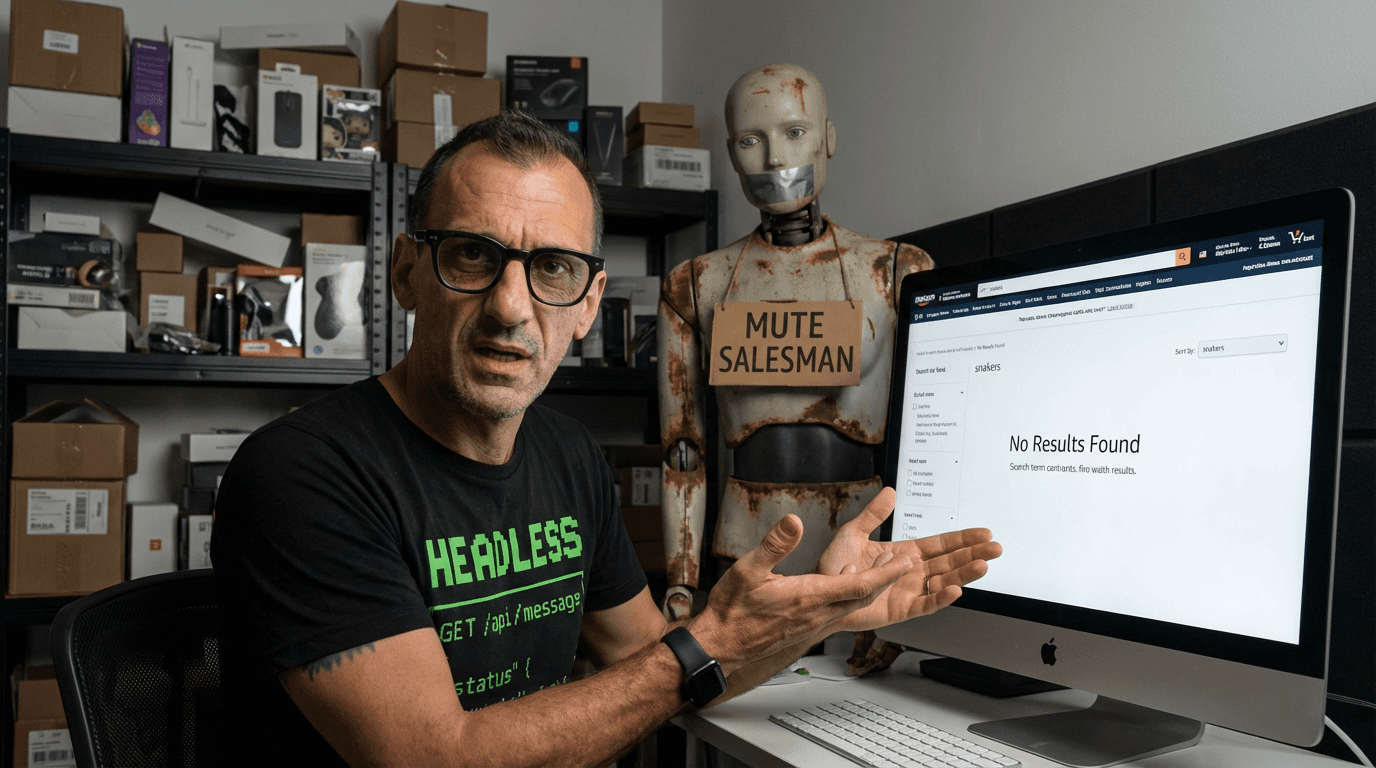
Your Best Salesperson is Mute (And You Are Ignoring Him)
Your site’s search bar converts three times better than any page you have ever designed. Yet you ignore it like the gross profit of a failed startup.
Walk into a store and ask the clerk: "Do you have red running shoes?" If he stares at you in silence or leads you to the cookware aisle, what do you do? You leave. Naturally. Yet, this is the service you offer every single day to your online customers, at scale, with a chilling presumption: that they will keep browsing anyway.
Wednesday, October 1, 2025
Written by
Alex Andone
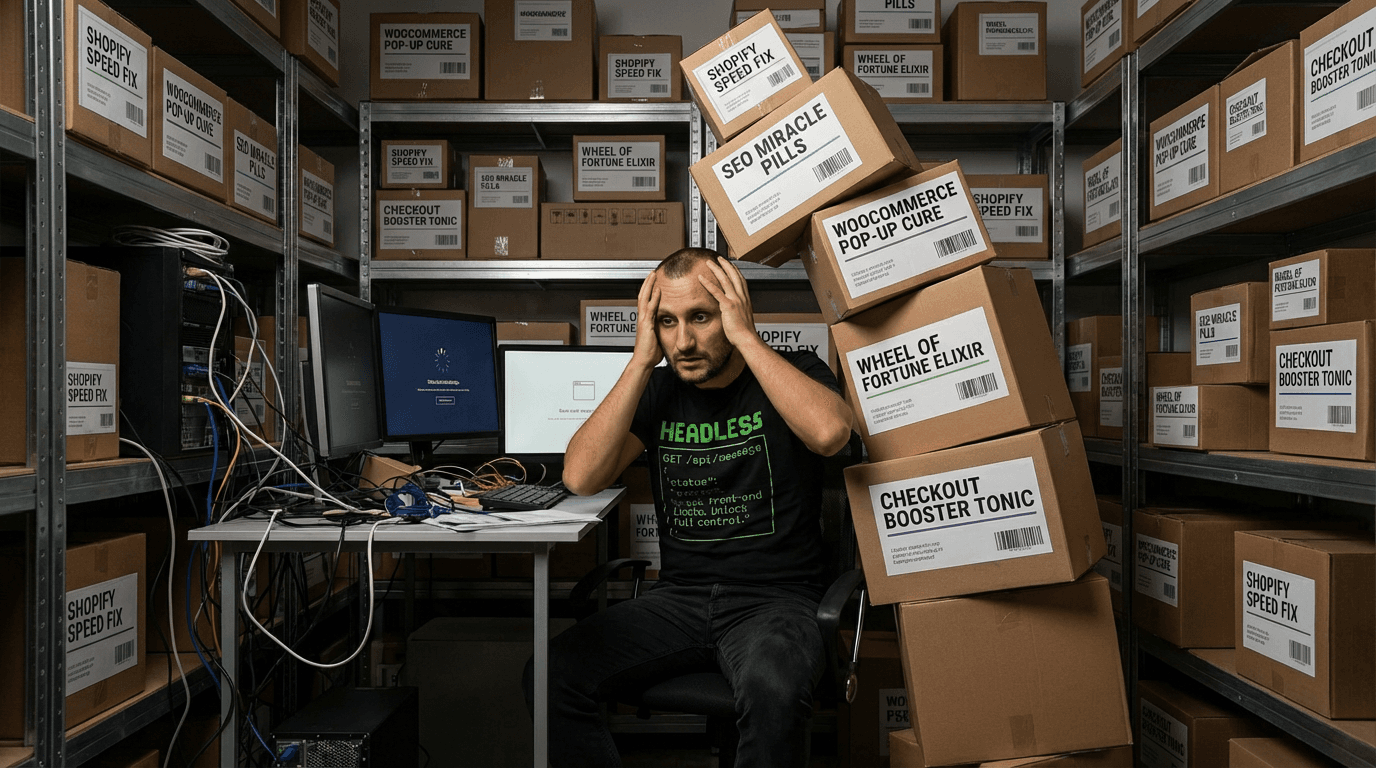
Your E-Commerce Store Doesn’t Need a Pharmacy. It Needs a Detox.
Your e-commerce site isn't slow because you aren't giving it enough traffic. It is slow because you are giving it too many drugs.
Every application you install is a promise of efficiency—and a ticking time bomb. I once thought I was building a modern online store. In reality, I built a museum of bad decisions. If this sounds familiar, you are about to discover why most e-commerce sites suffer from a pathology I call "The Obese Stack," and more importantly, how to cure it.
Headless is Not a Trend. It’s the Moment You Stop Being a Prisoner of a Theme.
Tuesday, October 21, 2025
written by
Co/Founder
Headless: Everyone Talks About It, No One Knows What It Is
You will hear this word everywhere: Headless. The problem is that no one can explain what it is without boring you to death. Let's solve that problem now. No jargon. Just business.
Traditional Architecture: A Comfortable Prison
Before understanding Headless, you must understand what it means to be non-headless.
Imagine your traditional e-commerce store—the one you use on Shopify or another standard platform—as a prefabricated house. Everything is pre-assembled. The walls, the roof, the windows come from a catalog. It is solid, functional, delivered in two weeks, and costs little.
You live well in it. Until you notice a fundamental flaw: the backend and the frontend are welded together.
The Backend is the engine (orders, products, money).
The Frontend is the paint (what the customer sees).
In a traditional setup, these two worlds are chained. If you want to change the frontend, the backend often says "no." If you want extreme performance, the backend holds you back because it wasn't built for speed—it was built for safety.
The result? Three enormous problems:
Mediocre Speed. Every time a customer opens a page, the server reconstructs it from scratch. A millisecond here, a second there. The page "builds" itself before the customer's eyes. It’s adequate, but adequate loses you 7-8% of conversions.
The Illusion of Creativity. Your designer draws something wonderful. The developer says: "The theme doesn't support this." Compromise becomes the norm.
You Are Trapped. Your store lives only on the website. Want a mobile app? Start from scratch. Want to sell in the metaverse? Build again. There is no central brain.
Headless: Cutting the Chain
Now comes the revolution. Headless means exactly this: we cut the weld. We divorce the backend from the frontend.
The Backend stays on Shopify. Why? Because Shopify is the best commercial engine in the world. It manages money and logistics perfectly. Replacing it would be like swapping a Formula 1 engine for a lawnmower engine.
The Frontend? We build it from scratch. Brick by brick. Using ultra-modern tech (React, Next.js). The loading speeds change from "fast enough" to instantaneous. The pages don't "load"; they appear.
Here is the magic that follows:
Speed that converts. 40% of visitors abandon a site if it takes more than 3 seconds to load. Headless puts you light years ahead.
Total Freedom. If you can draw it, we can code it. 3D products? Narrative navigation? Hyper-personalization? The frontend is now a blank canvas.
True Omnichannel. Your backend becomes the brain. It sends data to your website, your mobile app, your smartwatch app, or your in-store kiosk. One brain, infinite faces.
The 3 Pillars of Superiority
Allow me to be blunt. Headless wins on three fronts that the market no longer tolerates:
Performance. It isn't just speed; it is psychology. Your brain associates speed with quality. A slow site is a slow brand. An instant site is a brand that knows its stuff.
Conversion. Amazon and Google proved it: every 100 milliseconds of latency reduction increases revenue by 1%. Do the math on your annual turnover. Headless pays for itself.
Invulnerability. Being on five channels simultaneously (Web, App, Social, Retail, IoT) gives you a competitive moat that is nearly impossible to cross.
Who Doesn't Need Headless?
I must be honest. If you sell t-shirts in a small niche, bill €500k a year, and convert at 3%, Headless is a useless luxury. Keep the standard theme. Invest in marketing. Not everyone needs a Ferrari.
But here is the "but" that changes everything. Today you are small. Tomorrow, your competitor implements Headless. Their pages load in 0.8 seconds. They convert at 5%. They have double your budget. You are still competing with a theme identical to ten other brands.
Who needs it today? Brands with vision. Brands that refuse to be commodities. Companies eyeing the metaverse or immersive experiences. If you believe the frontend is part of your identity, not just a technical detail, you need this.
The Hidden Costs of Standing Still
Let’s address the elephant in the room. Headless costs money. It requires skilled developers, maintenance, and governance. It is an investment that makes CFOs squint.
But do you know what costs much more? Standing still.
Losing 8% of conversions monthly because the site is slow.
Being unable to launch a mobile app quickly.
Having a fragile experience dependent on a theme you don't control.
Being one of ten identical brands in your category.
That cost is hidden, but real. It is revenue never realized.
The Final Verdict
Headless isn't the future. It is the present that smart brands have already mastered. Your competitors aren't talking about it yet? Perfect. Start now. In two years, when everyone panics and says "we have to do Headless," you will already be 24 months ahead.
The question isn't: "Should we do Headless?" The question is: "How much longer can we afford not to?"
More Briefs
Your Site is Beautiful. Too Bad it Doesn’t Sell.
A perfect interface has zero value when the server collapses at the first whip-crack of real traffic.
Accessibility is Not Charity. It is Pure Business.
The Uncomfortable Truth: You Are Closing Your Wallet to 1 in 6 Europeans.
Innovation is Not a Trend: It is a Responsibility We Didn’t Ask For
Technical innovation that fails to solve a real problem is not innovation. It’s just expensive noise.
Your Best Salesperson is Mute (And You Are Ignoring Him)
Your site’s search bar converts three times better than any page you have ever designed. Yet you ignore it like the gross profit of a failed startup.
Your E-Commerce Store Doesn’t Need a Pharmacy. It Needs a Detox.
Your e-commerce site isn't slow because you aren't giving it enough traffic. It is slow because you are giving it too many drugs.
Headless is Not a Trend. It’s the Moment You Stop Being a Prisoner of a Theme.
Tuesday, October 21, 2025
written by
Co/Founder
Headless: Everyone Talks About It, No One Knows What It Is
You will hear this word everywhere: Headless. The problem is that no one can explain what it is without boring you to death. Let's solve that problem now. No jargon. Just business.
Traditional Architecture: A Comfortable Prison
Before understanding Headless, you must understand what it means to be non-headless.
Imagine your traditional e-commerce store—the one you use on Shopify or another standard platform—as a prefabricated house. Everything is pre-assembled. The walls, the roof, the windows come from a catalog. It is solid, functional, delivered in two weeks, and costs little.
You live well in it. Until you notice a fundamental flaw: the backend and the frontend are welded together.
The Backend is the engine (orders, products, money).
The Frontend is the paint (what the customer sees).
In a traditional setup, these two worlds are chained. If you want to change the frontend, the backend often says "no." If you want extreme performance, the backend holds you back because it wasn't built for speed—it was built for safety.
The result? Three enormous problems:
Mediocre Speed. Every time a customer opens a page, the server reconstructs it from scratch. A millisecond here, a second there. The page "builds" itself before the customer's eyes. It’s adequate, but adequate loses you 7-8% of conversions.
The Illusion of Creativity. Your designer draws something wonderful. The developer says: "The theme doesn't support this." Compromise becomes the norm.
You Are Trapped. Your store lives only on the website. Want a mobile app? Start from scratch. Want to sell in the metaverse? Build again. There is no central brain.
Headless: Cutting the Chain
Now comes the revolution. Headless means exactly this: we cut the weld. We divorce the backend from the frontend.
The Backend stays on Shopify. Why? Because Shopify is the best commercial engine in the world. It manages money and logistics perfectly. Replacing it would be like swapping a Formula 1 engine for a lawnmower engine.
The Frontend? We build it from scratch. Brick by brick. Using ultra-modern tech (React, Next.js). The loading speeds change from "fast enough" to instantaneous. The pages don't "load"; they appear.
Here is the magic that follows:
Speed that converts. 40% of visitors abandon a site if it takes more than 3 seconds to load. Headless puts you light years ahead.
Total Freedom. If you can draw it, we can code it. 3D products? Narrative navigation? Hyper-personalization? The frontend is now a blank canvas.
True Omnichannel. Your backend becomes the brain. It sends data to your website, your mobile app, your smartwatch app, or your in-store kiosk. One brain, infinite faces.
The 3 Pillars of Superiority
Allow me to be blunt. Headless wins on three fronts that the market no longer tolerates:
Performance. It isn't just speed; it is psychology. Your brain associates speed with quality. A slow site is a slow brand. An instant site is a brand that knows its stuff.
Conversion. Amazon and Google proved it: every 100 milliseconds of latency reduction increases revenue by 1%. Do the math on your annual turnover. Headless pays for itself.
Invulnerability. Being on five channels simultaneously (Web, App, Social, Retail, IoT) gives you a competitive moat that is nearly impossible to cross.
Who Doesn't Need Headless?
I must be honest. If you sell t-shirts in a small niche, bill €500k a year, and convert at 3%, Headless is a useless luxury. Keep the standard theme. Invest in marketing. Not everyone needs a Ferrari.
But here is the "but" that changes everything. Today you are small. Tomorrow, your competitor implements Headless. Their pages load in 0.8 seconds. They convert at 5%. They have double your budget. You are still competing with a theme identical to ten other brands.
Who needs it today? Brands with vision. Brands that refuse to be commodities. Companies eyeing the metaverse or immersive experiences. If you believe the frontend is part of your identity, not just a technical detail, you need this.
The Hidden Costs of Standing Still
Let’s address the elephant in the room. Headless costs money. It requires skilled developers, maintenance, and governance. It is an investment that makes CFOs squint.
But do you know what costs much more? Standing still.
Losing 8% of conversions monthly because the site is slow.
Being unable to launch a mobile app quickly.
Having a fragile experience dependent on a theme you don't control.
Being one of ten identical brands in your category.
That cost is hidden, but real. It is revenue never realized.
The Final Verdict
Headless isn't the future. It is the present that smart brands have already mastered. Your competitors aren't talking about it yet? Perfect. Start now. In two years, when everyone panics and says "we have to do Headless," you will already be 24 months ahead.
The question isn't: "Should we do Headless?" The question is: "How much longer can we afford not to?"
More Briefs
Your Site is Beautiful. Too Bad it Doesn’t Sell.
A perfect interface has zero value when the server collapses at the first whip-crack of real traffic.
Accessibility is Not Charity. It is Pure Business.
The Uncomfortable Truth: You Are Closing Your Wallet to 1 in 6 Europeans.
Innovation is Not a Trend: It is a Responsibility We Didn’t Ask For
Technical innovation that fails to solve a real problem is not innovation. It’s just expensive noise.
Your Best Salesperson is Mute (And You Are Ignoring Him)
Your site’s search bar converts three times better than any page you have ever designed. Yet you ignore it like the gross profit of a failed startup.
Your E-Commerce Store Doesn’t Need a Pharmacy. It Needs a Detox.
Your e-commerce site isn't slow because you aren't giving it enough traffic. It is slow because you are giving it too many drugs.

Let's talk.
Partners,
not vendors.
No sales scripts. Just an honest conversation about your objectives. Book a slot directly with our experts to see if we are the right strategic fit for your brand.

Let's talk.
Partners,
not vendors.
No sales scripts. Just an honest conversation about your objectives. Book a slot directly with our experts to see if we are the right strategic fit for your brand.
Let's talk.
Partners,
not vendors.
No sales scripts. Just an honest conversation about your objectives. Book a slot directly with our experts to see if we are the right strategic fit for your brand.