Your site’s search bar converts three times better than any page you have ever designed. Yet you ignore it like the gross profit of a failed startup.
Tuesday, October 14, 2025
written by
Co/Founder

Your Best Salesperson is Mute (And You Are Ignoring Him)
Walk into a store and ask the clerk: "Do you have red running shoes?" If he stares at you in silence or leads you to the cookware aisle, what do you do? You leave. Naturally.Yet, this is the service you offer every single day to your online customers, at scale, with a chilling presumption: that they will keep browsing anyway.
The truth no one wants to admit is that search isn't a "feature." It is your best salesperson. The problem is, you never gave him decent training.
The Homepage Fetish
I look at websites every day, and I see a disturbing phenomenon: e-commerce managers investing fortunes in the homepage. Blinding colors, image carousels, giant banners, "modern" layouts. It is the theater of online sales. But the theater is empty when the customer already knows what they want.
The data is ruthless. Users who use the "Search" function convert up to three times more than those who browse through categories. Not 30% more. Three times.
Yet, companies continue to invest in homepage beauty as if they were selling paintings at the Louvre, when they are actually selling running shoes.
Why this monstrous difference? Because the customer who searches has something the casual browser lacks: Intent. They know what they want. They have virtually arrived with a credit card in hand. And you, instead of letting them finish the transaction, tell them your company history through stupid images and aspirational copy.
The Silence of Dumb Search
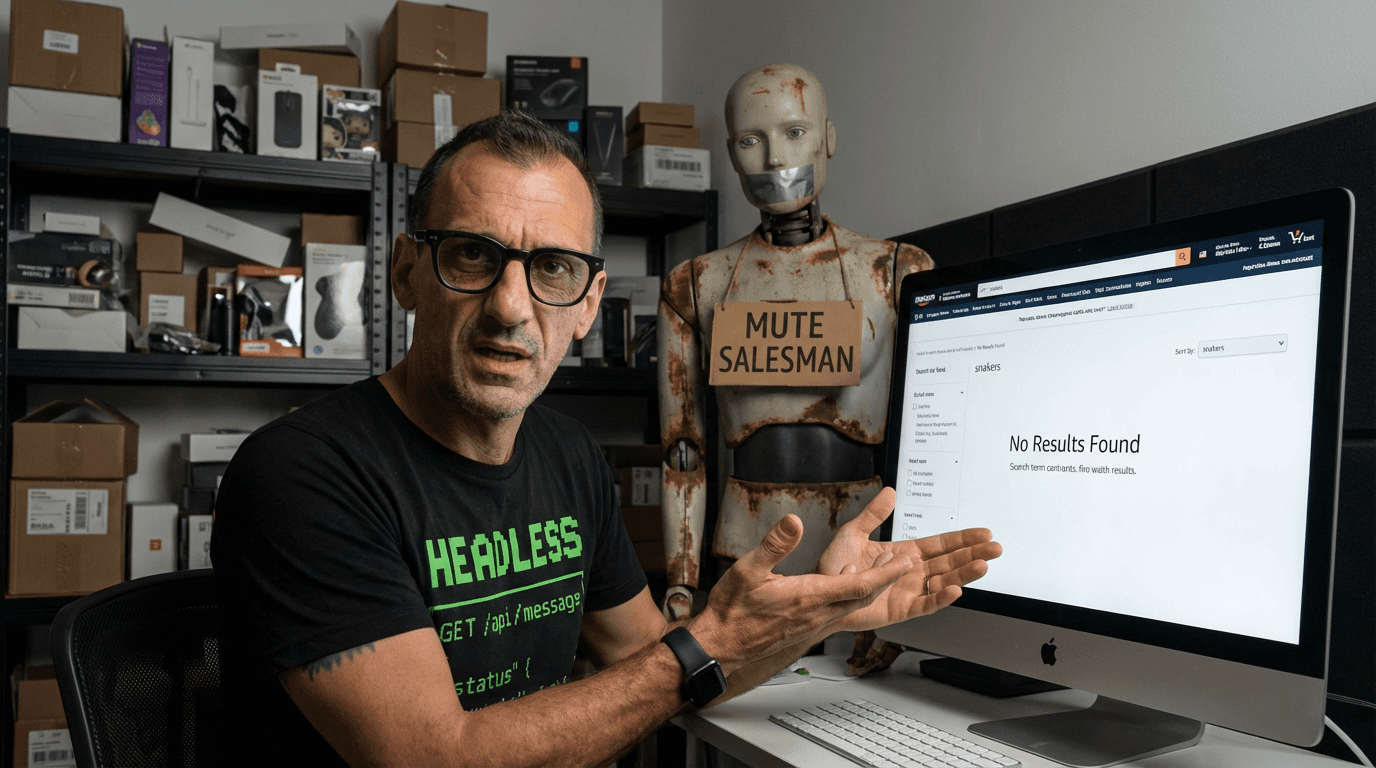
Now we get to the real crime. Many of you have a search engine that works like a drunk bouncer: Exact match or nothing. The customer types "snakers" and the system, with the rigidity of a 19th-century encyclopedia, replies: "No results found." As if a typo were a personal insult.
Or this: The customer searches for "summer shoe" and your database has 300 beautiful sandals. But the title says "sandal," not "summer shoe." Result: Zero results. Zero conversions. Zero revenue.
The customer assumes you don't have it. In two seconds, they are on Amazon, where the search engine knows that "summer shoe" and "sandal" are family. You lost a sure sale. And it isn't the customer's fault. It is yours.
The Technology Already Exists
This is where the story gets truly frustrating. Because today—not ten years from now—the technology to solve this already exists.
Intelligent AI-based search engines understand context. They correct typos. They propose relevant alternatives even when the customer doesn't know exactly how to phrase it. If you search for "grey jogging shoes," the system knows you mean running shoes in grey, even if your database calls them "Trainers - Anthracite."
They also know what your competitors are doing. If millions of customers search for "sneakers" and your system stays loyal to internal nomenclature that calls everything "footwear," then your system isn't precise. It is provincial. It's like running a restaurant with a menu written in Morse code and wondering why customers go elsewhere.
Where the Magic Happens
Let me be brutal: It doesn't matter how beautiful your homepage is. It doesn't matter if you commissioned a Webby Award-winning designer. It doesn't matter if you spent thousands photographing products from impossible angles.
If the customer enters, searches, and the system doesn't understand what they want, you lose.
Let me repeat that number, because you probably stopped listening: Search users convert 3x more.
If today 10% of your visitors search and convert at 5%, while 90% browse casually at 1.5%, then 40% of your total revenue comes from that little search bar. Which, according to your design metrics, is "minimal," "discreet," and "clean." Sure, it's discreet. It is also your most productive employee.
The Opportunity You Are Giving Away
Here is what happens when you truly optimize search. When a customer types something, the system understands what they mean, not just what they wrote.
It corrects typos without arrogance.
If they type "summer shoe" and you sell sandals, the system knows.
If they type "jogging shoe" and you call them "running trainers," the system bridges the gap.
The result? The customer doesn't bounce. They don't go to Amazon. They find what they want in two seconds, see the product, and buy.
This isn't a marginal 5% improvement. This is the difference between a brand that dominates and a brand that bleeds market share to smarter competitors.
The Choice You Must Make
Today you have a choice. You can keep burning budget on the homepage. More banners, more carousels, more parallax effects that please designers but sell nothing.
Or, you can stop polishing the front window and start optimizing the heart of your operation.
You can build a search engine that is truly intelligent. That is human. That is fast. That learns from customer behavior. If you do, you will see numbers you’ve never seen before. Because you are finally doing what your customers have been asking since day one: Listening to what they say, understanding what they want, and giving it to them.
Search isn't an ornament. It isn't a "nice to have." It is the fundamental mechanism of your online sales. And you are ignoring it.
More Briefs
Friday, November 7, 2025
Written by
Alex Andone
Your Site is Beautiful. Too Bad it Doesn’t Sell.
A perfect interface has zero value when the server collapses at the first whip-crack of real traffic.
I'll tell you a secret developers won't tell you: most e-commerce sites fail not due to a lack of vision, but due to an unforgivable negligence towards reality. We build cathedrals of elegant code. We create mesmerizing animations. Then Black Friday arrives. And we discover we built a magnificent theater with no plumbing system.

Tuesday, November 4, 2025
Written by
Mauro Morero
Accessibility is Not Charity. It is Pure Business.
The Uncomfortable Truth: You Are Closing Your Wallet to 1 in 6 Europeans.
In 2025, Europe isn't giving away gifts. The new Digital Accessibility Act is not a favor to the disabled. It is a lifeline thrown to entrepreneurs who still haven't realized they are ignoring a parallel market worth billions. Many brands are scrambling with the mindset of a driver trying to avoid a speeding ticket: "Let's do this to avoid the fine." It is the most expensive strategic error you can make. Because you are looking at the problem from the wrong side of the mirror.

Sunday, October 26, 2025
Written by
Mauro Morero
Innovation is Not a Trend: It is a Responsibility We Didn’t Ask For
Technical innovation that fails to solve a real problem is not innovation. It’s just expensive noise.
In the world of e-commerce, we hear promises of "digital transformation" three times a week. Startups promise to reinvent the wheel. Consultants sell roadmaps copied from other consultants. But the truth no one wants to admit is this: 90% of "innovation" is simply wallpaper over unresolved problems. This article isn't about what is possible with technology. It's about what is actually worth doing.

Tuesday, October 21, 2025
Written by
Alex Andone
Headless: Everyone Talks About It, No One Knows What It Is
Headless is Not a Trend. It’s the Moment You Stop Being a Prisoner of a Theme.
You will hear this word everywhere: Headless. The problem is that no one can explain what it is without boring you to death. Let's solve that problem now. No jargon. Just business.

Wednesday, October 1, 2025
Written by
Alex Andone
Your E-Commerce Store Doesn’t Need a Pharmacy. It Needs a Detox.
Your e-commerce site isn't slow because you aren't giving it enough traffic. It is slow because you are giving it too many drugs.
Every application you install is a promise of efficiency—and a ticking time bomb. I once thought I was building a modern online store. In reality, I built a museum of bad decisions. If this sounds familiar, you are about to discover why most e-commerce sites suffer from a pathology I call "The Obese Stack," and more importantly, how to cure it.
Your site’s search bar converts three times better than any page you have ever designed. Yet you ignore it like the gross profit of a failed startup.
Tuesday, October 14, 2025
written by
Co/Founder
Your Best Salesperson is Mute (And You Are Ignoring Him)
Walk into a store and ask the clerk: "Do you have red running shoes?" If he stares at you in silence or leads you to the cookware aisle, what do you do? You leave. Naturally.Yet, this is the service you offer every single day to your online customers, at scale, with a chilling presumption: that they will keep browsing anyway.
The truth no one wants to admit is that search isn't a "feature." It is your best salesperson. The problem is, you never gave him decent training.
The Homepage Fetish
I look at websites every day, and I see a disturbing phenomenon: e-commerce managers investing fortunes in the homepage. Blinding colors, image carousels, giant banners, "modern" layouts. It is the theater of online sales. But the theater is empty when the customer already knows what they want.
The data is ruthless. Users who use the "Search" function convert up to three times more than those who browse through categories. Not 30% more. Three times.
Yet, companies continue to invest in homepage beauty as if they were selling paintings at the Louvre, when they are actually selling running shoes.
Why this monstrous difference? Because the customer who searches has something the casual browser lacks: Intent. They know what they want. They have virtually arrived with a credit card in hand. And you, instead of letting them finish the transaction, tell them your company history through stupid images and aspirational copy.
The Silence of Dumb Search
Now we get to the real crime. Many of you have a search engine that works like a drunk bouncer: Exact match or nothing. The customer types "snakers" and the system, with the rigidity of a 19th-century encyclopedia, replies: "No results found." As if a typo were a personal insult.
Or this: The customer searches for "summer shoe" and your database has 300 beautiful sandals. But the title says "sandal," not "summer shoe." Result: Zero results. Zero conversions. Zero revenue.
The customer assumes you don't have it. In two seconds, they are on Amazon, where the search engine knows that "summer shoe" and "sandal" are family. You lost a sure sale. And it isn't the customer's fault. It is yours.
The Technology Already Exists
This is where the story gets truly frustrating. Because today—not ten years from now—the technology to solve this already exists.
Intelligent AI-based search engines understand context. They correct typos. They propose relevant alternatives even when the customer doesn't know exactly how to phrase it. If you search for "grey jogging shoes," the system knows you mean running shoes in grey, even if your database calls them "Trainers - Anthracite."
They also know what your competitors are doing. If millions of customers search for "sneakers" and your system stays loyal to internal nomenclature that calls everything "footwear," then your system isn't precise. It is provincial. It's like running a restaurant with a menu written in Morse code and wondering why customers go elsewhere.
Where the Magic Happens
Let me be brutal: It doesn't matter how beautiful your homepage is. It doesn't matter if you commissioned a Webby Award-winning designer. It doesn't matter if you spent thousands photographing products from impossible angles.
If the customer enters, searches, and the system doesn't understand what they want, you lose.
Let me repeat that number, because you probably stopped listening: Search users convert 3x more.
If today 10% of your visitors search and convert at 5%, while 90% browse casually at 1.5%, then 40% of your total revenue comes from that little search bar. Which, according to your design metrics, is "minimal," "discreet," and "clean." Sure, it's discreet. It is also your most productive employee.
The Opportunity You Are Giving Away
Here is what happens when you truly optimize search. When a customer types something, the system understands what they mean, not just what they wrote.
It corrects typos without arrogance.
If they type "summer shoe" and you sell sandals, the system knows.
If they type "jogging shoe" and you call them "running trainers," the system bridges the gap.
The result? The customer doesn't bounce. They don't go to Amazon. They find what they want in two seconds, see the product, and buy.
This isn't a marginal 5% improvement. This is the difference between a brand that dominates and a brand that bleeds market share to smarter competitors.
The Choice You Must Make
Today you have a choice. You can keep burning budget on the homepage. More banners, more carousels, more parallax effects that please designers but sell nothing.
Or, you can stop polishing the front window and start optimizing the heart of your operation.
You can build a search engine that is truly intelligent. That is human. That is fast. That learns from customer behavior. If you do, you will see numbers you’ve never seen before. Because you are finally doing what your customers have been asking since day one: Listening to what they say, understanding what they want, and giving it to them.
Search isn't an ornament. It isn't a "nice to have." It is the fundamental mechanism of your online sales. And you are ignoring it.
More Briefs
Your Site is Beautiful. Too Bad it Doesn’t Sell.
A perfect interface has zero value when the server collapses at the first whip-crack of real traffic.
Accessibility is Not Charity. It is Pure Business.
The Uncomfortable Truth: You Are Closing Your Wallet to 1 in 6 Europeans.
Innovation is Not a Trend: It is a Responsibility We Didn’t Ask For
Technical innovation that fails to solve a real problem is not innovation. It’s just expensive noise.
Headless: Everyone Talks About It, No One Knows What It Is
Headless is Not a Trend. It’s the Moment You Stop Being a Prisoner of a Theme.
Your E-Commerce Store Doesn’t Need a Pharmacy. It Needs a Detox.
Your e-commerce site isn't slow because you aren't giving it enough traffic. It is slow because you are giving it too many drugs.
Your site’s search bar converts three times better than any page you have ever designed. Yet you ignore it like the gross profit of a failed startup.
Tuesday, October 14, 2025
written by
Co/Founder
Your Best Salesperson is Mute (And You Are Ignoring Him)
Walk into a store and ask the clerk: "Do you have red running shoes?" If he stares at you in silence or leads you to the cookware aisle, what do you do? You leave. Naturally.Yet, this is the service you offer every single day to your online customers, at scale, with a chilling presumption: that they will keep browsing anyway.
The truth no one wants to admit is that search isn't a "feature." It is your best salesperson. The problem is, you never gave him decent training.
The Homepage Fetish
I look at websites every day, and I see a disturbing phenomenon: e-commerce managers investing fortunes in the homepage. Blinding colors, image carousels, giant banners, "modern" layouts. It is the theater of online sales. But the theater is empty when the customer already knows what they want.
The data is ruthless. Users who use the "Search" function convert up to three times more than those who browse through categories. Not 30% more. Three times.
Yet, companies continue to invest in homepage beauty as if they were selling paintings at the Louvre, when they are actually selling running shoes.
Why this monstrous difference? Because the customer who searches has something the casual browser lacks: Intent. They know what they want. They have virtually arrived with a credit card in hand. And you, instead of letting them finish the transaction, tell them your company history through stupid images and aspirational copy.
The Silence of Dumb Search
Now we get to the real crime. Many of you have a search engine that works like a drunk bouncer: Exact match or nothing. The customer types "snakers" and the system, with the rigidity of a 19th-century encyclopedia, replies: "No results found." As if a typo were a personal insult.
Or this: The customer searches for "summer shoe" and your database has 300 beautiful sandals. But the title says "sandal," not "summer shoe." Result: Zero results. Zero conversions. Zero revenue.
The customer assumes you don't have it. In two seconds, they are on Amazon, where the search engine knows that "summer shoe" and "sandal" are family. You lost a sure sale. And it isn't the customer's fault. It is yours.
The Technology Already Exists
This is where the story gets truly frustrating. Because today—not ten years from now—the technology to solve this already exists.
Intelligent AI-based search engines understand context. They correct typos. They propose relevant alternatives even when the customer doesn't know exactly how to phrase it. If you search for "grey jogging shoes," the system knows you mean running shoes in grey, even if your database calls them "Trainers - Anthracite."
They also know what your competitors are doing. If millions of customers search for "sneakers" and your system stays loyal to internal nomenclature that calls everything "footwear," then your system isn't precise. It is provincial. It's like running a restaurant with a menu written in Morse code and wondering why customers go elsewhere.
Where the Magic Happens
Let me be brutal: It doesn't matter how beautiful your homepage is. It doesn't matter if you commissioned a Webby Award-winning designer. It doesn't matter if you spent thousands photographing products from impossible angles.
If the customer enters, searches, and the system doesn't understand what they want, you lose.
Let me repeat that number, because you probably stopped listening: Search users convert 3x more.
If today 10% of your visitors search and convert at 5%, while 90% browse casually at 1.5%, then 40% of your total revenue comes from that little search bar. Which, according to your design metrics, is "minimal," "discreet," and "clean." Sure, it's discreet. It is also your most productive employee.
The Opportunity You Are Giving Away
Here is what happens when you truly optimize search. When a customer types something, the system understands what they mean, not just what they wrote.
It corrects typos without arrogance.
If they type "summer shoe" and you sell sandals, the system knows.
If they type "jogging shoe" and you call them "running trainers," the system bridges the gap.
The result? The customer doesn't bounce. They don't go to Amazon. They find what they want in two seconds, see the product, and buy.
This isn't a marginal 5% improvement. This is the difference between a brand that dominates and a brand that bleeds market share to smarter competitors.
The Choice You Must Make
Today you have a choice. You can keep burning budget on the homepage. More banners, more carousels, more parallax effects that please designers but sell nothing.
Or, you can stop polishing the front window and start optimizing the heart of your operation.
You can build a search engine that is truly intelligent. That is human. That is fast. That learns from customer behavior. If you do, you will see numbers you’ve never seen before. Because you are finally doing what your customers have been asking since day one: Listening to what they say, understanding what they want, and giving it to them.
Search isn't an ornament. It isn't a "nice to have." It is the fundamental mechanism of your online sales. And you are ignoring it.
More Briefs
Your Site is Beautiful. Too Bad it Doesn’t Sell.
A perfect interface has zero value when the server collapses at the first whip-crack of real traffic.
Accessibility is Not Charity. It is Pure Business.
The Uncomfortable Truth: You Are Closing Your Wallet to 1 in 6 Europeans.
Innovation is Not a Trend: It is a Responsibility We Didn’t Ask For
Technical innovation that fails to solve a real problem is not innovation. It’s just expensive noise.
Headless: Everyone Talks About It, No One Knows What It Is
Headless is Not a Trend. It’s the Moment You Stop Being a Prisoner of a Theme.
Your E-Commerce Store Doesn’t Need a Pharmacy. It Needs a Detox.
Your e-commerce site isn't slow because you aren't giving it enough traffic. It is slow because you are giving it too many drugs.

Let's talk.
Partners,
not vendors.
No sales scripts. Just an honest conversation about your objectives. Book a slot directly with our experts to see if we are the right strategic fit for your brand.

Let's talk.
Partners,
not vendors.
No sales scripts. Just an honest conversation about your objectives. Book a slot directly with our experts to see if we are the right strategic fit for your brand.
Let's talk.
Partners,
not vendors.
No sales scripts. Just an honest conversation about your objectives. Book a slot directly with our experts to see if we are the right strategic fit for your brand.